
Complete Removal Guide
Introduction
Few household accidents feel as catastrophic as watching a bottle of nail polish tumble from a countertop and splash across your carpet. The vibrant pigment that makes nail polish so appealing also makes it one of the most intimidating stains to tackle on carpet fibers. Unlike water-based spills, nail polish contains solvents and resins that bond aggressively with textile fibers, creating a stain that seems impossible to remove.
The good news is that nail polish can be removed from carpet — but the approach differs significantly from other stain removal processes. Using the wrong method (such as scrubbing with water) can actually set the stain permanently. This comprehensive guide covers every aspect of nail polish removal from carpet, from immediate first aid to professional restoration options.
At Double Take Carpet Cleaning, we’ve handled countless nail polish emergencies across Utah homes. If you’re facing a stubborn polish stain or simply want professional peace of mind, call us at 801-377-1107 or visit dtcarpets.com.
Why Nail Polish Is So Difficult to Remove from Carpet
Nail polish is chemically designed to be durable and long-lasting on nails. Unfortunately, those same properties make it aggressive on carpet fibers.
The Chemistry of Nail Polish
| Component | Function | Why It’s Problematic on Carpet |
|---|---|---|
| Nitrocellulose | Film-forming polymer | Bonds tightly to carpet fibers |
| Ethyl acetate / Butyl acetate | Solvent | Carries pigment deep into fibers |
| Tosylamide-formaldehyde resin | Adhesion promoter | Creates permanent bond if dried |
| Dibutyl phthalate | Plasticizer | Makes polish flexible, harder to crack off |
| Pigments / Titanium dioxide | Color | Stains fibers at microscopic level |
| Benzophenone | UV stabilizer | Resists fading, making stain persistent |
Acetone-Based vs Non-Acetone Polish Removers
| Feature | Acetone Remover | Non-Acetone Remover |
|---|---|---|
| Active ingredient | Acetone (100% or concentrated) | Ethyl acetate, isopropyl alcohol |
| Removal speed | Fast (seconds) | Slow (minutes of soaking) |
| Carpet safety risk | Can dissolve synthetic fibers (nylon, polyester, olefin) | Lower risk of fiber damage |
| Odor | Strong, lingering | Milder |
| Effectiveness on dried polish | Excellent | Moderate |
| Recommended for carpet | Only with extreme caution | Better first choice |
Critical warning: Test ANY remover on an inconspicuous carpet area first. Acetone can dissolve nylon carpets — the most common residential carpet fiber.
Step-by-Step: How to Get Nail Polish Out of Carpet
Immediate First Aid (First 60 Seconds)
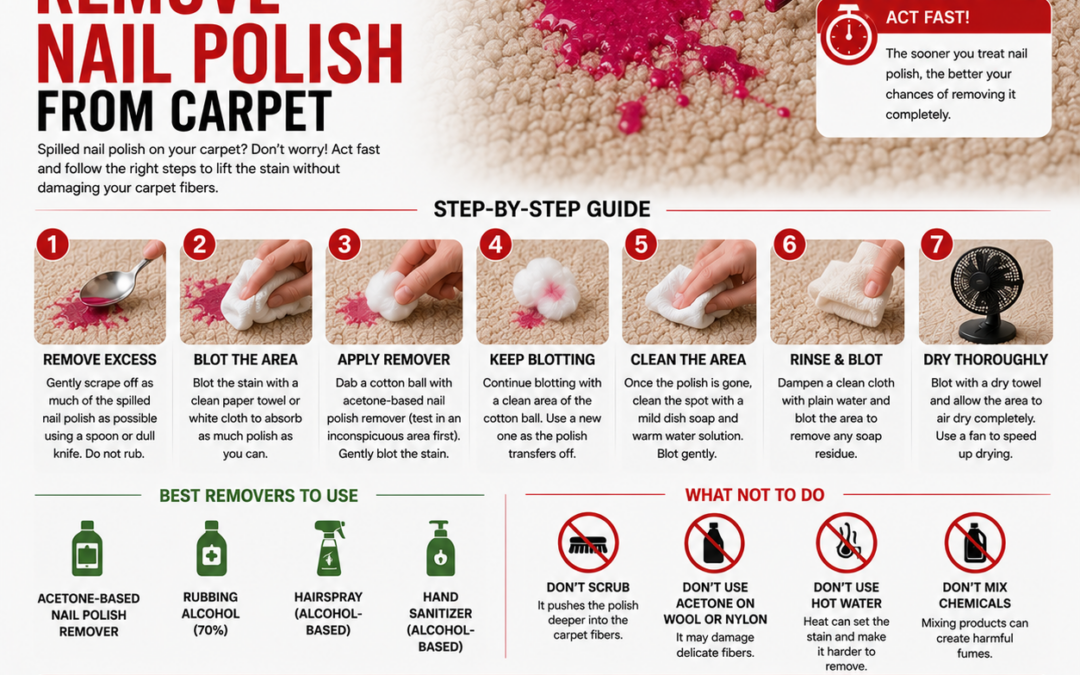
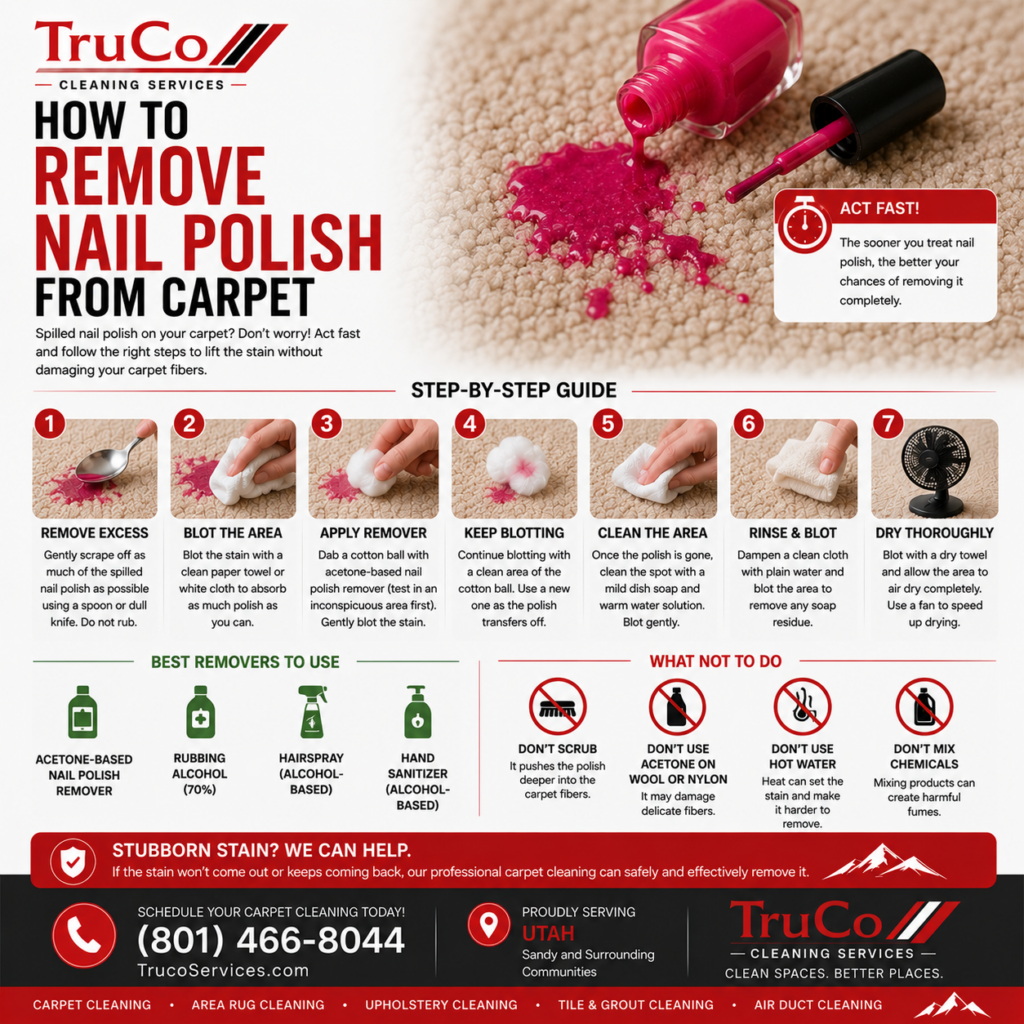
- Do NOT rub or scrub. Rubbing spreads the polish deeper into fibers and widens the stain area.
- Blot with a white paper towel or clean cloth. Gently press to absorb as much wet polish as possible. Work from the outside inward.
- Do NOT use water. Water does not dissolve nail polish — it can make the stain spread or turn milky.
- If the polish is still wet, use the dull edge of a butter knife or credit card to carefully scrape excess from the surface.
Method 1: Non-Acetone Nail Polish Remover (Safest First Attempt)
Best for: Fresh stains, synthetic carpets, colored carpets
What you need:
– Non-acetone nail polish remover (ethyl acetate based)
– White cotton cloths or paper towels
– Small bowl
– Clean water
– Vacuum
Steps:
1. Blot any wet polish from the surface. Do not rub.
2. Apply a small amount of non-acetone remover to a white cloth — do not pour directly onto carpet.
3. Gently dab (do not rub) the stain from the outer edge toward the center.
4. As the polish transfers to your cloth, rotate to a clean section of the cloth.
5. Continue until no more polish transfers.
6. Blot with a damp cloth (water only) to remove any remover residue.
7. Place a dry towel over the area with weight (such as a heavy book) for 30 minutes.
8. Vacuum to restore texture.
Method 2: Acetone Method (For Stubborn or Dried Stains)
Best for: Dried polish, old stains, natural fiber carpets (wool, sisal)
Warning: Acetone can discolor or dissolve synthetic carpet fibers. Always test in a hidden area first (inside a closet or under furniture).
What you need:
– 100% pure acetone (not acetone-based nail polish remover with added dyes or conditioners)
– Eyedropper or small syringe
– White cloths
– Protective gloves
– Well-ventilated area
Steps:
1. Perform a patch test on hidden carpet area. Apply one drop of acetone, wait 30 seconds, blot. Check for color transfer or fiber damage.
2. If the test passes, dampen a white cloth with acetone — not soaking wet.
3. Gently dab the stain. The polish should begin dissolving almost immediately.
4. Use a dry section of the cloth to absorb the dissolved polish.
5. Repeat with fresh acetone until the stain is gone or no longer lifting.
6. Blot with water to remove residual acetone.
7. Place absorbent towels over the area with weight for several hours.
Method 3: Rubbing Alcohol / Isopropyl Alcohol
Best for: Synthetic carpets where acetone is too risky
What you need:
– 91% isopropyl alcohol (higher concentration works better)
– White cloths
– Small spray bottle (optional)
– Vacuum
Steps:
1. Saturate a white cloth with isopropyl alcohol.
2. Press onto the polish stain for 30-60 seconds to allow the alcohol to dissolve the polish.
3. Gently blot and lift. The polish should transfer to the cloth.
4. Replace the cloth with a clean section as polish transfers.
5. Continue until the stain is removed.
6. Blot with water and dry thoroughly.
Method 4: Hairspray Hack (Household Alternative)
Best for: Small, fresh stains when you don’t have nail polish remover
Most aerosol hairsprays contain alcohol, which can dissolve fresh nail polish.
Steps:
1. Spray a generous amount of hairspray directly onto the stain.
2. Let it sit for 30-60 seconds to break down the polish.
3. Blot with a clean white cloth.
4. Repeat until the stain lifts.
5. Rinse with water and blot dry.
How to Remove Dried Nail Polish from Carpet
Once nail polish has dried, it forms a hard, plastic-like bond with carpet fibers. Here’s the specialized approach:
- Freeze the polish. Place an ice pack or ice cubes in a sealed plastic bag on the stain. Let it sit for 10-15 minutes until the polish becomes brittle.
- Crack the polish. Gently tap the frozen polish with a spoon or the back of a butter knife. The frozen polish should shatter into small pieces.
- Vacuum the fragments. Use a vacuum with a crevice tool to suction up the broken polish pieces.
- Treat remaining residue. Any remaining pigment can be treated with the non-acetone remover or alcohol method above.
- Repeat if needed. Thick polish buildup may require multiple freeze-and-crack cycles.
Removing Nail Polish from Different Carpet Types
| Carpet Material | Acetone Safe? | Recommended Method |
|---|---|---|
| Nylon | No – can dissolve fibers | Non-acetone remover or alcohol |
| Polyester/Olefin | No – can melt fibers | Isopropyl alcohol only |
| Wool | Yes – natural fiber is resistant | Acetone (test first) or non-acetone |
| Olefin (Berber) | No – extremely sensitive | Professional cleaning recommended |
| Triexta (SmartStrand) | No – can damage | Alcohol or professional cleaning |
| Sisal/Seagrass | Yes – natural fiber | Acetone, then water rinse |
| Carpet Tile (commercial) | Varies by fiber type | Check manufacturer spec sheet |
5 Critical Mistakes to Avoid
- Never use hot water. Heat can set nail polish stains permanently by bonding the resins to fibers.
- Never scrub aggressively. Scrubbing forces the pigment deeper into the carpet backing.
- Don’t use colored cloths. The dye from a colored rag can transfer to your carpet. Always use white.
- Don’t mix chemicals. Never combine nail polish remover with carpet cleaning solutions or bleach — toxic fumes can result.
- Don’t give up too soon. Nail polish may require 5-10 round trips with solvent before fully lifting.
When to Call a Professional Carpet Cleaner
- Large spills (covering more than a dinner-plate-sized area)
- Carpet with padding soak-through – if polish has reached the carpet backing or pad
- Valuable or antique carpets – Oriental rugs, wool carpets, or heirloom pieces
- Old, set-in stains that have been through multiple at-home attempts
- Carpet discoloration after using acetone or remover
- Delicate fibers (viscose, rayon, silk-blend carpets)
Double Take Carpet Cleaning uses professional-grade spotting agents and truck-mounted hot water extraction that can often salvage carpets that at-home methods have failed. We serve Utah County, Salt Lake County, and surrounding areas.
Frequently Asked Questions
Q1: Can nail polish remover ruin my carpet?
Yes — especially if it contains acetone and your carpet is made of synthetic fibers (nylon, polyester, olefin). Always test in an inconspicuous area first. Non-acetone removers are significantly safer for synthetic carpets.
Q2: How long does nail polish take to dry on carpet?
Nail polish typically begins drying on carpet within 1-3 minutes and can be fully dry within 15-30 minutes depending on the amount spilled and carpet thickness. That’s why immediate action is crucial.
Q3: Will hydrogen peroxide remove nail polish from carpet?
Hydrogen peroxide is not effective on nail polish. It works well for organic stains (blood, wine, grass) but does not dissolve the resins and polymers in nail polish. Stick with acetone, non-acetone remover, or alcohol.
Q4: Can I use WD-40 to remove nail polish from carpet?
Some people report success using WD-40 on nail polish stains because its petroleum-based formula helps dissolve the polish. However, WD-40 leaves its own oily residue that must be thoroughly cleaned afterward with dish soap and water, and it can attract dirt over time if not fully removed.
Q5: What about using vinegar and baking soda?
This popular DIY combination is ineffective on nail polish. Vinegar (acidic) and baking soda (alkaline) do not dissolve the synthetic resins in nail polish. Save this method for organic stains.
Q6: How do I remove nail polish from carpet without nail polish remover?
Rubbing alcohol (91% or higher) is the best alternative. Hairspray (aerosol) can also work for fresh stains. In a pinch, hand sanitizer (which contains alcohol) can be applied directly to the stain.
Q7: Does nail polish ruin carpet permanently?
Not necessarily. If treated quickly and correctly, most nail polish stains can be completely removed. However, if the polish has soaked through to the carpet padding, it may leave a lasting shadow or discoloration.
Q8: Can a carpet cleaner remove dried nail polish?
Professional carpet cleaners have commercial-grade solvents and extraction equipment that can remove even dried nail polish. Truck-mounted hot water extraction combined with professional spotting agents gives the best chance of complete removal.
Q9: Is it safe to use nail polish remover on wool carpet?
Wool is generally more resistant to acetone than synthetic fibers, but you should still test in a hidden area. Wool can be damaged by excessive moisture and harsh chemicals, so go slowly and blot rather than soak.
Q10: How do I get glitter nail polish out of carpet?
Glitter nail polish requires extra care because the glitter particles can become embedded in fibers. Use the freeze-and-crack method first to remove visible glitter, then treat remaining pigment with non-acetone remover. Vacuum thoroughly afterward.
Q11: What if the nail polish stain has been there for months?
Old, set-in nail polish stains are significantly harder to remove but not always impossible. Start with the freeze-and-crack method, then apply non-acetone remover with patience. Professional cleaning may be your best option.
Q12: Will nail polish removal fade my carpet color?
Aggressive solvents can sometimes lift carpet dye along with the polish. This is more common with acetone on synthetic fibers. Always test first and work from the edges inward to minimize any potential halo effect.
Q13: How do I clean up nail polish remover smell from carpet?
Ventilate the room thoroughly. Sprinkle baking soda over the treated area, let it sit for several hours, then vacuum. If the odor persists, a professional cleaning can remove chemical residues.
Q14: Can I paint over a nail polish stain on carpet?
Carpet dye or touch-up markers are available for small stains, but this should be a last resort. Professional stain removal should always be attempted first, as dye matching is difficult and can look worse than the original stain.
Q15: Does professional carpet cleaning help with future nail polish stains?
Carpet protector treatments (such as Scotchgard) applied after professional cleaning can help resist liquid absorption, giving you more time to respond to future spills. However, no protector makes carpet completely stain-proof.
Summary
- Act fast — but don’t scrub. Blot and use the right solvent.
- Test first — always test removers on a hidden carpet area.
- Choose your solvent carefully — non-acetone remover or isopropyl alcohol for synthetic carpets; acetone for natural fibers or dried stains.
- Be patient — nail polish removal often requires multiple applications.
- Know when to call a pro — for large spills, old stains, or delicate carpets.
For professional carpet cleaning, stain removal, and carpet protector application, call Double Take Carpet Cleaning at 801-377-1107 or visit dtcarpets.com. We serve homes and businesses throughout Utah with guaranteed results.
