
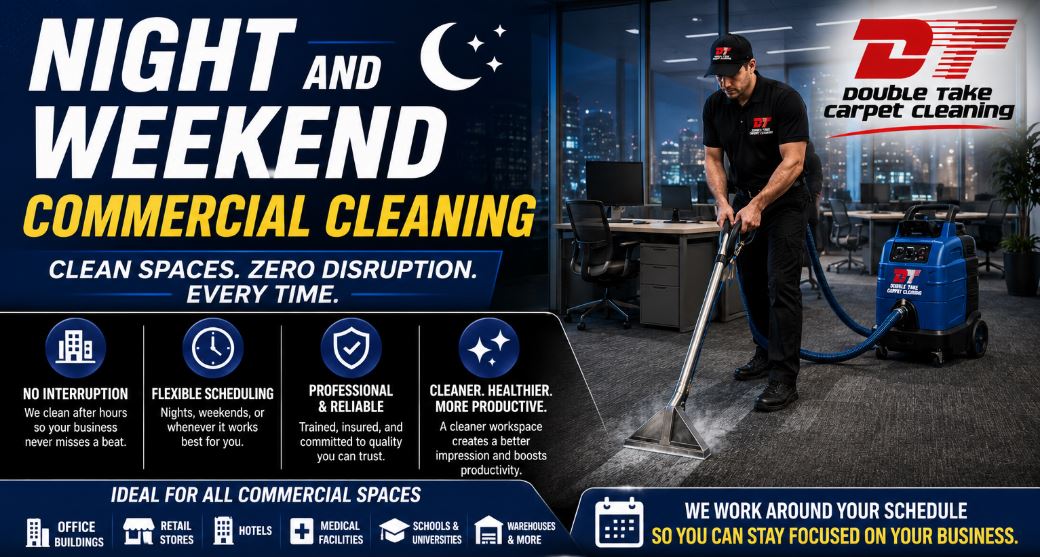
The case for after-hours cleaning
Who needs after-hours cleaning:
- Medical and dental offices (patient appointments cannot be interrupted)
- Retail stores (cleaning during open hours looks unprofessional)
- Restaurants and food service (health codes and customer experience)
- Law firms and financial services (client-facing professionalism)
- Call centers and 24/7 operations (need to schedule during lowest traffic)
- Schools and daycare (children cannot be present during chemical use)
- Gyms and fitness centers (equipment in constant use during hours)
Who can clean during business hours:
- General office buildings with low customer traffic
- Warehouses and manufacturing (if cleaning can be zoned)
- Construction sites (no public access)
- Buildings with dedicated cleaning closets and low occupancy
Cost comparison — daytime vs after-hours
| Cost Factor | Daytime | After-Hours |
|---|---|---|
| Cleaning crew labor | $25-$45/hr | $35-$65/hr (overtime) |
| Minimum crew size | 1-2 people | 2-4 people (security pairing) |
| Equipment | Standard | May need portable (no truck access) |
| Building access | Normal | May need security coordination |
| HVAC operation | Normal operation | May need to run after hours |
| Total premium | Baseline | +20-40% |
| Typical office (10,000 sq ft) | $800-$1,500 | $1,000-$2,100 |
Logistics of after-hours commercial cleaning
Building access — The cleaning company needs: after-hours key code or key fob, alarm system codes, knowledge of security protocols, after-hours contact information.
Equipment — Truck-mounted equipment may not be accessible if the building is locked. Portable extraction units are quieter and easier to bring inside but less powerful.
HVAC and drying — After-hours HVAC may be on a timer that shuts off at 6 PM. Without proper ventilation, carpets and upholstery take longer to dry.
Noise considerations — Truck-mounted equipment is loud. Portable equipment is quieter. Some buildings have noise restrictions after 10 PM.
Safety — Night crews typically work in pairs for safety. The building may require the cleaning company to provide proof of insurance and sign liability waivers.
Weekend cleaning — a popular middle ground
| Factor | Weekday Daytime | Weekday After-Hours | Weekend |
|---|---|---|---|
| Disruption | High | None | None |
| Labor cost | Standard | +20-40% | Standard (Sat) or + (Sun) |
| Building access | Easy | Requires coordination | Easy (daytime) |
| HVAC | Normal | May need override | Normal |
| Parking | Competing with employees | Easy | Easy |
| Noise concerns | Low | Moderate | Low |
Zoned cleaning — a smarter approach
| Zone | Cleaning Schedule | Method | Disruption |
|---|---|---|---|
| Zone A — Reception/lobby | Week 1, Wed 2-4 PM | Encapsulation | 2 hours, low traffic time |
| Zone B — Open office | Week 3, Fri after 5 PM | Encapsulation | Minimal (end of week) |
| Zone C — Conference rooms | Week 5, between meetings | Spot cleaning + HWE | Per meeting schedule |
| Deep HWE — All zones | Quarterly, Sunday | HWE | Weekend, no disruption |
What Utah businesses should look for in an after-hours cleaner
- Experience with commercial accounts
- Flexible scheduling
- Encapsulation capability
- Truck-mounted and portable equipment
- IICRC certification
- Written contract with scope of work
- Security clearance — background-checked employees
Frequently Asked Questions
Is after-hours cleaning more expensive?
Yes, typically 20-40% more due to overtime labor rates and equipment logistics.
Is weekend cleaning cheaper than weekday after-hours?
Saturday is usually standard rate. Sunday may have overtime rates.
How do I prep the office for after-hours cleaning?
Clear floors, secure sensitive documents, leave a light on for the crew, and provide access instructions.
Can cleaning be done during business hours without disruption?
Yes, using encapsulation (low-moisture) in zones. Each zone is affected for 1-2 hours.
What if my building has after-hours security restrictions?
The cleaning company should coordinate with your security team in advance.
How do I know if I need after-hours cleaning?
If your business operates during cleaning hours and disruption would cost more than the cleaning premium, after-hours is worth it.
Can truck-mounted equipment be used after hours?
Yes, if the building allows truck access to the exterior. Otherwise, portable equipment is used.
How long does after-hours cleaning take?
A 10,000 sq ft office with HWE takes 4-8 hours with a 2-person crew. Encapsulation takes 2-4 hours.
Does the cleaning crew need supervision?
Most commercial cleaners work independently. A point of contact should be available by phone.
What about cleaning medical offices after hours?
Medical offices are ideal for after-hours cleaning due to patient privacy and infection control requirements.
Can I get a discount for recurring after-hours contracts?
Yes. Monthly or quarterly contracts typically include volume discounts that offset the after-hours premium.
Is encapsulation safe for after-hours use?
Yes. Encapsulation has no fumes, dries in 1-2 hours, and leaves no sticky residue.
What if the cleaning runs longer than expected?
Discuss overtime policies in your contract. Most companies will notify you if extra time is needed.
Do I need to be present during after-hours cleaning?
Not typically. A key handoff and written instructions are usually sufficient.
What is the best cleaning schedule for a Utah office?
Encapsulation monthly during business hours (zoned), plus deep HWE quarterly on weekends.
Need non-disruptive commercial cleaning?
At Double Take Carpet Cleaning, we offer flexible after-hours and weekend cleaning for Utah businesses, from Sandy to Provo. Call us at 801-377-1107 or visit dtcarpets.com to schedule.
