
What’s the difference between steam cleaning and dry cleaning for carpets?
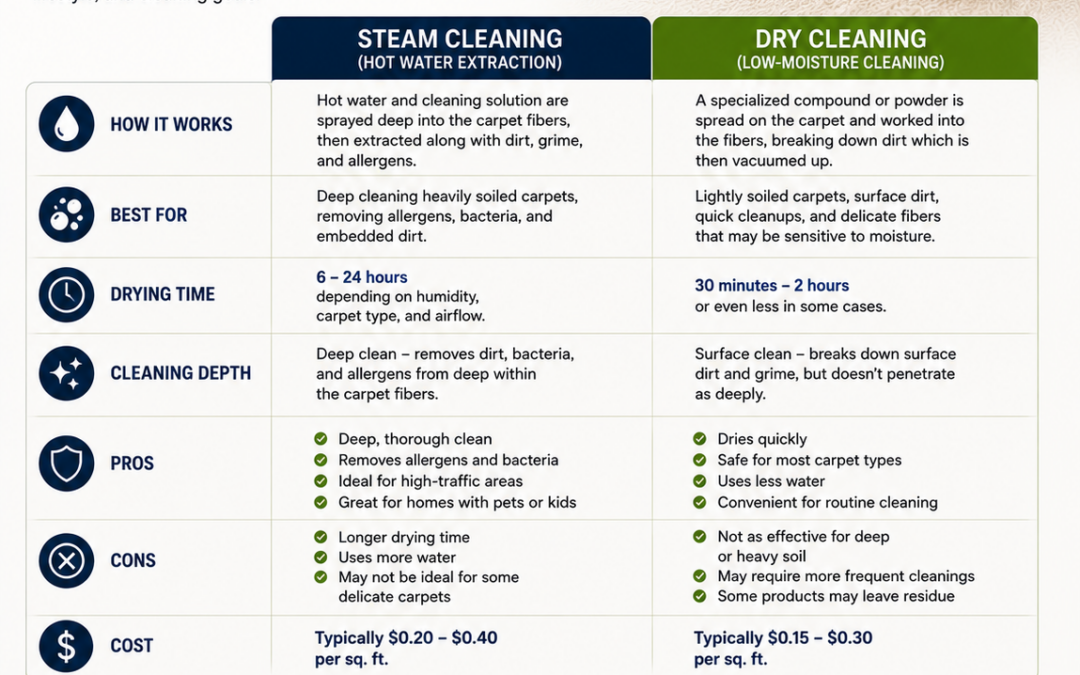
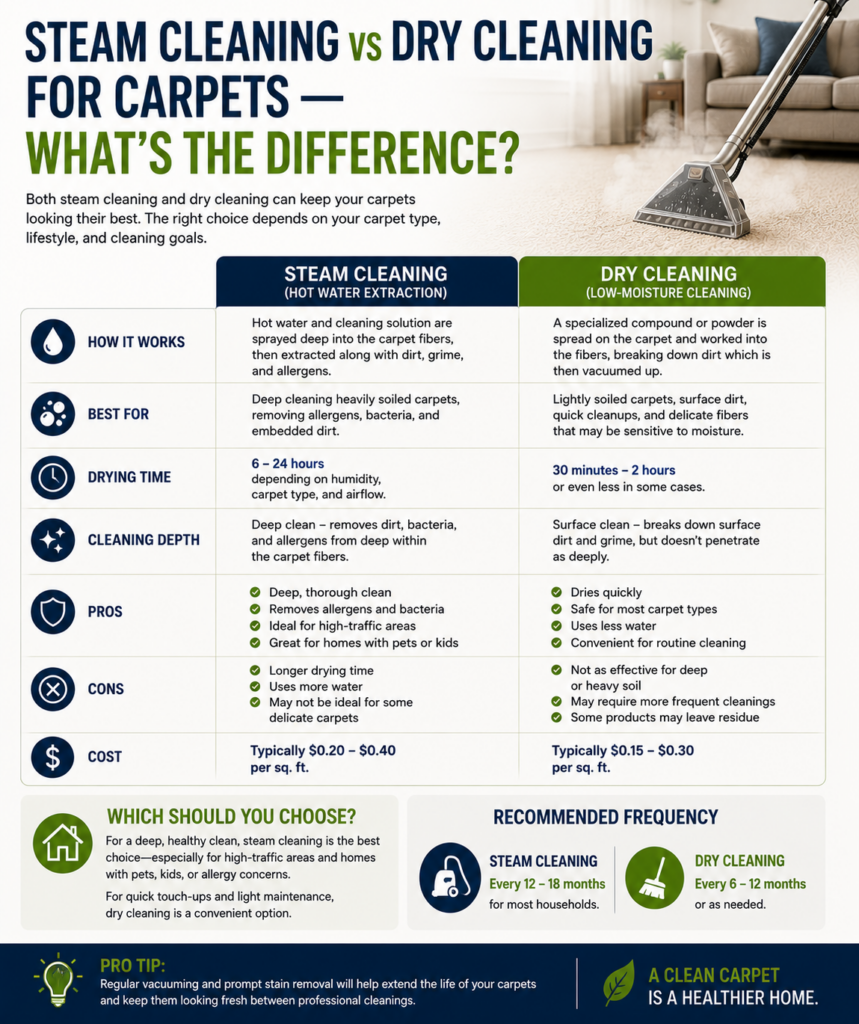
The main difference is that steam cleaning (hot water extraction) uses hot water and cleaning solution injected into carpet fibers under high pressure, then extracted with a powerful vacuum — it cleans deep into the padding. Dry cleaning uses a chemical foam or powder applied to the carpet surface, then vacuumed up with little to no water. Steam cleaning is recommended by most carpet manufacturers because it removes embedded dirt, allergens, and bacteria. Dry cleaning offers faster drying times (1-2 hours vs 4-8 hours) but only cleans the surface level of the carpet.
How steam cleaning (hot water extraction) works
Despite the name “steam cleaning,” the method actually uses hot water — typically around 200°F — not steam. The process works like this:
- A cleaning solution is pre-sprayed onto the carpet to loosen dirt and break down stains
- A powerful truck-mounted or commercial-grade machine injects hot water into the carpet fibers under high pressure
- The same machine immediately extracts the water, dirt, and cleaning agents using a powerful vacuum
- The carpet is left clean, with only minimal moisture remaining
This method flushes contaminants from deep within the carpet fibers and even the padding layer. The Carpet & Rug Institute (CRI) recommends hot water extraction as the most effective cleaning method for maintaining carpet appearance and extending its life.
How dry cleaning works
Dry carpet cleaning uses chemical compounds rather than water. There are two main methods:
Absorbent compound (dry compound) — A fine powder or granules mixed with cleaning agents are spread over the carpet. A rotary machine brushes the compound into the fibers, where it absorbs dirt. After drying, the compound is vacuumed up.
Encapsulation — A synthetic foam is applied to the carpet that forms crystals around dirt particles as it dries. Once dry, the crystals are vacuumed away, taking the dirt with them.
Dry cleaning’s main advantage is speed — carpets are dry and usable within 1-2 hours. However, because no water is used to flush the fibers, deep-down dirt and allergens remain in the carpet.
Steam cleaning vs dry cleaning — side-by-side comparison
| Factor | Steam Cleaning (Hot Water Extraction) | Dry Cleaning |
|---|---|---|
| Cleaning depth | Deep — reaches carpet padding | Surface-level only |
| Drying time | 4-8 hours | 1-2 hours |
| Dirt removal | Flushes out embedded dirt, allergens, bacteria | Absorbs surface dirt; leaves deep contaminants |
| Manufacturer recommended | Yes — most carpet warranties require it | No — may void some warranties |
| Best for | High-traffic areas, homes with kids/pets, allergies | Low-traffic areas, quick touch-ups, delicate fibers |
| Allergen removal | Excellent — removes dust mites, pollen, pet dander | Limited |
| Cost | $25-$50 per room | $20-$40 per room |
| Stain removal | Effective on most stains | Less effective on set-in stains |
| Residue left behind | Minimal if extracted properly | Cleaning compound residue may remain |
Which method do carpet manufacturers recommend?
The majority of carpet manufacturers — including Shaw, Mohawk, Stainmaster, and Anderson Tuftex — specify hot water extraction as the required cleaning method in their warranty terms. Many warranties require professional hot water extraction every 12-24 months to remain valid. Dry cleaning methods may not satisfy warranty requirements.
The CRI’s Seal of Approval program tests cleaning solutions and equipment specifically for hot water extraction systems, setting the standard for professional carpet cleaning effectiveness.
Which method is better for Utah homes?
For Utah homeowners, steam cleaning (hot water extraction) is generally the better choice:
- Utah’s dry climate means 4-8 hour drying times are easily achievable with proper ventilation and our low humidity
- Red clay dirt and dust are common in Utah — these fine particles embed deep in carpet and require flushing, not just surface absorption
- Winter salt and mud tracked in from Utah’s snowy months accumulates in carpet fibers over time and needs deep extraction
- Allergies affect many Utah residents — hot water extraction removes allergens that dry cleaning leaves behind
Are there situations where dry cleaning is better?
Dry cleaning can be appropriate for:
- Delicate or natural fiber carpets — wool, silk, or antique carpets that may shrink or be damaged by water
- Situations requiring immediate use — commercial spaces that cannot be out of service for hours
- Light maintenance cleaning — quick freshening between deep steam cleaning sessions
- Carpets with moisture sensitivity — some berber carpets or carpets on wooden subfloors where excess moisture is a concern
Frequently Asked Questions
Q1: Is steam cleaning really steam?
A: Despite the common name, “steam cleaning” actually uses hot water at around 200°F, not steam. True steam cleaning exists but is rarely used in residential carpet cleaning.
Q2: Does steam cleaning damage carpet?
A: No, not when done correctly by a professional using commercial-grade equipment. Over-wetting is the main risk, which is why professional extraction — removing nearly all water — is important.
Q3: How long does steam cleaned carpet take to dry?
A: With professional commercial-grade hot water extraction, carpets typically dry in 4 to 8 hours depending on humidity, airflow, and carpet thickness.
Q4: Does dry cleaning leave residue in carpet?
A: Some dry cleaning methods can leave chemical residue in the carpet that attracts dirt faster, causing carpets to resoil more quickly.
Q5: Which cleaning method kills dust mites?
A: Hot water extraction at temperatures above 130°F kills dust mites. Dry cleaning methods do not reach temperatures sufficient to kill them.
Q6: Can I steam clean wool carpet?
A: Wool carpet can be steam cleaned, but it requires lower temperatures and careful technique to avoid shrinkage. A professional with experience cleaning wool is recommended.
Q7: How often should I steam clean my carpets? (See our complete cleaning frequency guide)
A: For most homes, professional hot water extraction every 12 to 18 months is sufficient. Homes with kids, pets, or allergies should clean every 6 to 12 months.
Q8: Does professional steam cleaning remove pet stains?
A: Yes. Hot water extraction combined with pre-treatment and enzyme cleaners is the most effective method for removing pet stains and odors from carpet.
For most Utah homes, steam cleaning (hot water extraction) is the superior choice — it cleans deeper, removes allergens, and keeps your carpet warranty valid. While dry cleaning offers faster drying, it simply does not clean deep enough for the dirt, dust, and allergens that accumulate in Utah homes.
At Double Take Carpet Cleaning, we use commercial-grade hot water extraction equipment that delivers deeper cleaning and faster drying than consumer machines. We’ve been serving Sandy and Utah County families for over 25 years.
Ready for a deeper clean? Call us at 801-377-1107 or request a free quote online or visit dtcarpets.com to schedule your appointment.
