
Why does my carpet still smell after I cleaned up the pet accident?
The smell comes back because you only cleaned the surface. Pet urine contains uric acid crystals that soak through carpet fibers into the foam padding underneath. Standard household cleaners and even many store-bought pet stain removers only treat the top layer of carpet. The uric acid crystals remain in the padding, where they recrystallize when they dry and release odor again whenever humidity rises. This is why you may clean a spot, have it smell fine for a few days, only to have the odor return.
The science behind pet urine odor
Pet urine is composed of water, urea, uric acid, creatinine, and various salts. When urine dries, the uric acid forms crystals that bond to carpet fibers and padding. These crystals are not water-soluble — meaning they won’t dissolve with water-based cleaners. They sit dormant until humidity rises, then they absorb moisture from the air and release that characteristic ammonia-like odor.
This explains why:
- The smell is worse in summer or after rain (humidity reactivates the crystals)
- The smell seems to come and go (it’s humidity-dependent)
- Cleaning with water alone makes it worse (you’re reactivating the crystals without removing them)
Why common DIY methods fail
| Method | What It Does | Why It Fails |
|---|---|---|
| Vinegar and water | Neutralizes some ammonia | Doesn’t break down uric acid crystals |
| Baking soda | Absorbs surface moisture | Doesn’t reach padding; only masks odor temporarily |
| Hydrogen peroxide | Bleaches and disinfects | Can damage carpet color; doesn’t remove padding-level urine |
| Store-bought enzymatic spray | Surface enzyme action | Consumer-grade enzymes too weak for padding penetration |
| Rented steam cleaner | Surface cleaning only | Consumer machines lack heat and suction to reach padding |
| Carpet deodorizer powder | Masks smell with fragrance | Temporarily covers odor; doesn’t remove source |
What actually removes pet urine smell permanently
Professional enzyme treatment — Enzyme cleaners contain specific bacteria that digest the uric acid crystals in pet urine, breaking them down into carbon dioxide and water. Unlike chemical cleaners that simply mask odors, enzymes actually consume the source of the smell.
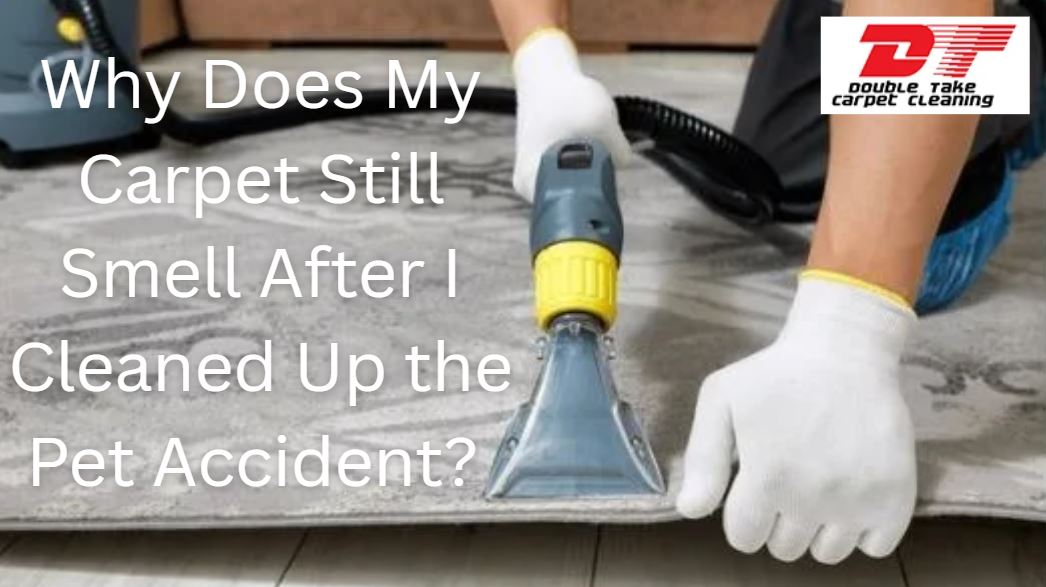
Hot water extraction — Professional hot water extraction uses high-pressure hot water to flush deep into carpet fibers and padding, then extracts everything with a powerful vacuum. This physically removes the urine that has penetrated the padding.
The combination is key — Applying enzyme treatment first, allowing it to dwell and digest the uric acid, then following with hot water extraction, is the most effective method for permanent odor removal. This is the standard process used by professional carpet cleaners for pet odor remediation.
How to tell if the urine reached the padding
- The smell returns a few days after cleaning
- You can smell it more strongly when you kneel close to the floor
- The carpet feels damp or spongy in that area even when dry elsewhere
- Your pet returns to the same spot repeatedly
- Dark staining visible from the back of the carpet
When is carpet replacement necessary?
In severe cases — repeated urination in the same area over months or years, or urine that has soaked through to the subfloor — the carpet and padding may need to be replaced. A professional carpet cleaning company can assess whether your carpet can be saved or if replacement is the better option.
Frequently Asked Questions
Q1: Why does my carpet smell worse after I cleaned it?
A: You likely reactivated the uric acid crystals with moisture without removing them, making the odor temporarily stronger.
Q2: How long does pet urine smell last in carpet?
A: Without proper treatment, pet urine smell can last indefinitely — years or the entire life of the carpet.
Q3: Does vinegar really remove pet urine smell?
A: Vinegar neutralizes some ammonia but does not break down uric acid crystals. It may mask the smell temporarily.
Q4: Can professional carpet cleaning remove old pet urine stains?
A: Yes. Professional enzyme treatment combined with hot water extraction can remove even old, set-in pet urine stains in most cases.
Q5: How much does professional pet urine removal cost?
A: Pet urine treatment typically adds $10 to $30 per spot to standard carpet cleaning costs.
Q6: Is enzyme cleaning safe for pets and children?
A: Yes. Professional-grade enzyme cleaners are non-toxic and safe once dry.
Q7: Can cat urine be removed from carpet?
A: Cat urine is more concentrated than dog urine, but professional treatment is effective in most cases.
Q8: Does baking soda remove pet urine odor?
A: Baking soda absorbs surface moisture and temporarily reduces odor, but it doesn’t remove the source.
If your carpet still smells after you’ve cleaned a pet accident, it’s because the urine has soaked into the padding where surface cleaners can’t reach it. The permanent solution is professional enzyme treatment combined with hot water extraction.
At Double Take Carpet Cleaning, we’ve helped Utah pet owners eliminate urine odors for over 25 years. We use professional-grade enzyme treatments combined with commercial hot water extraction.
Living with pet odors? Call us at 801-377-1107 or visit dtcarpets.com to schedule your pet urine treatment appointment.
