

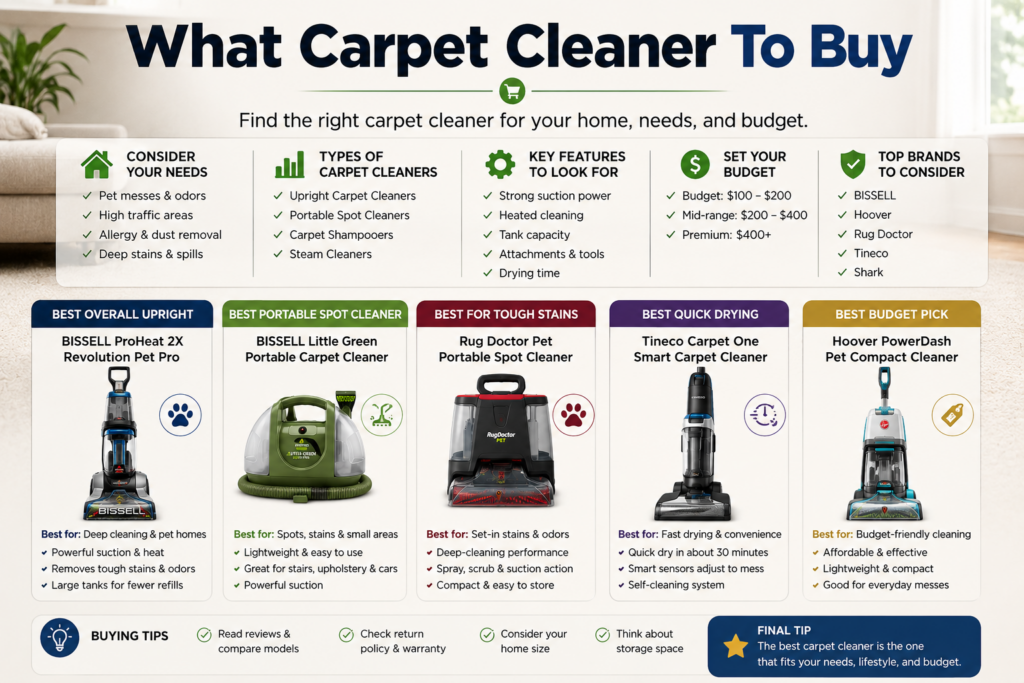
Choosing what carpet cleaner to buy comes down to matching the machine to your carpets, your messes, and how much work you want to do. For most homes, the best option is not the most expensive model, but the one that fits your floor type, cleaning frequency, drying expectations, and budget. Good carpet cleaners save money over time by reducing the need for professional spot treatments, helping with pet accidents, and keeping carpet fibers from holding dirt and odors.
The most important takeaway is simple: buy for your real cleaning needs, not for the biggest motor or the longest feature list. Upright carpet cleaners are best for whole-room deep cleaning, portable spot cleaners are better for stairs, upholstery, and pet messes, and lightweight or low-moisture options work best when convenience matters more than deep extraction. Expert guidance helps because the wrong choice can lead to over-wetting, slow drying, weak stain removal, or unnecessary wear on your carpet. This article breaks down how carpet cleaners work, what to look for, the biggest buying mistakes, and how to compare options with confidence.
What a carpet cleaner does
A carpet cleaner is a machine that sprays cleaning solution and water into carpet fibers, agitates the fibers, and then extracts the dirty liquid back out. In practical terms, it does more than a vacuum: it lifts embedded soil, tracked-in grime, food spills, and some pet stains that regular vacuuming cannot remove. The main components are the clean-water tank, dirty-water tank, brush roll or scrub system, suction system, and cleaning solution.
There are several common types. Upright carpet cleaners are the most common for whole rooms and deep cleaning. Portable spot cleaners are smaller and better for stairs, furniture, and isolated accidents. Some “carpet shampooers” emphasize scrubbing, while low-moisture or dry-style cleaners focus on faster drying and lighter maintenance. Consumer testing organizations and buying guides generally compare cleaning power, drying performance, tank size, ease of use, and whether the machine handles pet messes well.
What is included is the machine itself, the tanks, hoses or attachments, and usually a starter bottle of solution. What is not included is carpet type verification, stain pre-treatment for every mess, or a guarantee that every stain will disappear. For example, old dye stains, bleach spots, and set-in pet urine often need special treatment beyond any consumer cleaner.
9 buying factors that matter
1. Match the cleaner to the job
The biggest mistake is buying a machine that is wrong for the way you actually clean. If you need to clean an entire family room, a full-size upright is usually the right tool. If your main problem is pet accidents on stairs, a portable spot cleaner may be a better buy. One guide on carpet cleaner types notes that solution and machine type need to match, because portable formulas and upright formulas are not always interchangeable.
This matters because a machine that is too small becomes annoying to use, while a machine that is too large may be cumbersome and get used less often. Real-world consequences include incomplete cleaning, more frustration, and more money spent on the wrong device. A busy household with kids or pets may need both: an upright for deep cleaning and a portable for emergencies.
The best approach is to list your top three use cases before shopping. If one of those is “pet urine on a rug at 10 p.m.,” prioritize portability and fast access. If one is “spring-clean every carpeted room,” prioritize tank capacity, extraction, and drying performance.
2. Cleaning power is more than suction
Many buyers assume stronger suction automatically means better results, but carpet cleaning is a balance of spray, agitation, heat, and extraction. A machine can have strong suction and still leave stains behind if the brushes are weak or the solution delivery is poor. Recent product testing has shown that some of the top-performing machines stand out because they combine effective agitation with good drying, not just raw power.
This matters because stain removal is not only about lifting water back out. It is also about loosening dirt from fiber bases where vacuums cannot reach. If a cleaner uses poor brush action, you may end up over-wetting the carpet while still leaving residue in place. That can attract more dirt later.
Look for balanced performance instead of marketing claims. In reviews, prioritize cleaning results on set-in stains, drying time, and how well the unit handles edge areas and high-traffic paths. If you clean thick or plush carpet, pay special attention to agitation and extraction, not just wattage.
3. Drying time affects real-life use
A carpet cleaner that leaves carpets wet for too long can create problems even if it cleans well. Slow drying can make rooms unusable for hours, increase the chance of odor, and, in some cases, raise the risk of moisture-related issues if the carpet is over-saturated. That is why drying performance is a major factor in current lab testing and buying guides.
This matters most in homes with children, pets, or limited ventilation. If you clean a hallway before bedtime and it is still damp in the morning, the machine has not solved your problem completely. Faster drying also helps prevent the temptation to walk on the carpet too soon, which can re-soil fibers.
To handle this, look for strong extraction, separate clean and dirty tanks, and machines that are designed to avoid over-wetting. In practice, two slow passes are usually better than one flooding pass. If your carpet is delicate or your home is humid, a low-moisture approach may be more sensible than a heavy-duty washer.
4. Tank size changes convenience
Tank size is one of those details that seems minor until you use the machine. Small tanks are lighter and easier to carry, but they need frequent refilling and dumping. Large tanks reduce interruptions, but they also make the machine heavier and harder to maneuver, especially on stairs or across several rooms.
This matters because the best carpet cleaner is the one you will actually use without dreading the setup. A machine that requires constant water changes may discourage regular cleaning, which lets dirt build up and shortens carpet life. On the other hand, an oversized machine can be exhausting for one person to operate.
Think about your home layout. A compact apartment may be better served by a portable cleaner. A large house with multiple carpeted rooms may justify a bigger upright. If you have stairs, look closely at total weight when full, not just the empty machine weight.
5. Accessories often make the difference
The main machine is only part of the story. Upholstery tools, stair attachments, crevice nozzles, and hose length can determine whether a cleaner is practical for your home. Some models are excellent on open carpet but awkward for sofas, stairs, or corners. That means you may still need extra tools or a second device.
This matters because many carpet problems are not in the middle of a room. They show up at room edges, under furniture, on stairs, and on furniture fabric. A machine with poor attachments can force you to scrub by hand afterward, which reduces the value of the purchase.
When comparing models, check whether the spot tool is included, how long the hose is, and whether the attachments are easy to switch. For pet owners, a dedicated stain tool and a hose that can reach stairs are especially useful. For larger homes, a wide cleaning path can save time, but only if it still reaches tight spots.
6. Carpet type should guide the choice
Not every carpet can handle the same amount of moisture or scrubbing. Synthetic wall-to-wall carpet is usually more forgiving than wool, looped textures, or specialty rugs. One cleaning guide specifically warns that some solutions are better for artificial fibers while others are gentler on wool and hand-tufted rugs. That principle applies to machines too.
This matters because the wrong cleaner can leave residue, distort pile, or over-wet sensitive fibers. Delicate rugs may need a gentler method or professional service, while durable family-room carpet can usually handle a standard upright. If you ignore carpet type, you risk disappointing results or possible damage.
Check the care label if you have one. If the carpet manufacturer recommends low-moisture methods only, do not choose a heavy-water extraction machine just because it is popular. When in doubt, test a small hidden area first. For valuable rugs, specialty care may be safer than a consumer machine.
7. Pet messes require special attention
Pet owners often need more than general stain removal. Urine, vomit, and tracked litter can create odor issues that ordinary cleaning does not fully solve. Recent testing highlighted that the best machines for pet homes are the ones that remove both visible stains and odor, not just surface marks.
This matters because odor can linger deep in carpet backing and pad layers. A machine that only cleans the top fibers may make the area look better while the smell returns later. That is frustrating, and it can lead pets to re-soil the same area.
If pets are a major factor, prioritize strong extraction, a stain pre-treat option, and an easy-to-clean dirty tank. Search for models specifically reviewed for pet use. For severe urine damage, a machine alone may not be enough; you may need enzyme treatment or professional help if the pad and subfloor are affected.
8. Ease of maintenance protects performance
A carpet cleaner that is hard to rinse, dry, or store often becomes a neglected appliance. Dirty tanks, clogged brushes, and leftover residue can reduce cleaning performance and cause odors in the machine itself. Long-term ownership depends as much on cleanup after use as on the cleaning session itself.
This matters because many buyers only think about the first use. After a few months, the machine can become unpleasant if the brush roll traps hair or the tanks are difficult to empty. That leads to lower performance and less frequent use.
Look for washable parts, clear tank design, and simple brush access. If the machine has a filter or nozzle that needs regular cleaning, make sure that process is easy enough to do every time. A slightly less powerful machine that is easy to maintain may outperform a stronger machine that sits in the closet.
9. Price should be judged over time
The cheapest carpet cleaner is not always the best deal. Low-cost machines may save money upfront but frustrate you with poor extraction, smaller tanks, or weak attachments. Higher-priced machines may be worthwhile if they clean faster, dry better, and last longer.
This matters because the real value includes replacement parts, solution costs, time saved, and whether you avoid outside cleaning services. If a machine is used only once a year, a mid-range model may be enough. If you have kids, pets, or heavy traffic, paying more for reliability may save money and stress over time.
A practical rule is to buy one tier above the minimum if your household is demanding. That usually means choosing the model with good reviews for drying, reliability, and everyday usability rather than the one with the most aggressive advertising. In many homes, value comes from dependable performance rather than premium extras.
Costs of buying wrong
Buying the wrong carpet cleaner can cost more than the purchase price. Financially, you may pay for a machine that does not solve the problem, then spend again on a better unit, spot treatments, or professional cleaning. Time costs add up too, because weak cleaning means repeated passes, longer drying, and more cleanup. Emotional costs are real as well: people get frustrated when stains return, odors linger, or a “good deal” turns into clutter.
There can also be long-term consequences. Repeated over-wetting can stress carpet backing, and poor stain removal can let soils become permanent. In homes with pets, incomplete cleanup can encourage repeated accidents in the same area. Most of these costs are avoidable if you choose based on carpet type, mess type, and actual usage patterns rather than broad marketing claims.
How an expert helps
An experienced carpet-care professional helps by translating the problem into the right solution. They can identify whether you need an upright machine, a portable spot cleaner, a low-moisture option, or professional treatment instead. They also know how to avoid over-wetting, select compatible cleaning chemistry, and handle stubborn issues like urine odor or set-in stains.
That kind of guidance reduces trial and error. A professional can also help with prep, such as vacuuming, pre-treating traffic lanes, and testing delicate fibers before full cleaning. If something goes wrong, they can troubleshoot whether the problem is the machine, the solution, the carpet fiber, or the stain itself. For households that want to avoid damage and wasted money, expert advice often pays for itself quickly.
Main cleaning options
Upright carpet cleaners
Upright machines are the standard choice for full-room deep cleaning. They usually have larger tanks, wide cleaning paths, and stronger extraction, which makes them good for living rooms, bedrooms, and hallways. Many top consumer picks fall into this category because they balance power and coverage.
Their drawback is size and weight. They are less convenient for stairs, upholstery, and spot-only jobs. If most of your cleaning is small messes, an upright may be more machine than you need.
Portable spot cleaners
Portable cleaners are designed for accidents, pet messes, stairs, and furniture. They are easier to carry and often easier to store. They are the best choice when you need fast response rather than whole-house coverage.
Their limitation is scale. They can be slower for large carpeted areas and may not replace a full-size machine for annual deep cleaning. Still, for households with pets, they can be the most practical first purchase.
Low-moisture or dry-style options
Low-moisture systems aim to reduce drying time and make cleaning more convenient. They can be useful in humid homes, on delicate carpets, or for maintenance between deeper cleanings. They are less disruptive and often easier to fit into a weekly routine.
Their tradeoff is depth. For heavy soil, spilled drinks, and pet accidents, they may not clean as aggressively as a true extraction machine. They are best when convenience matters more than maximum stain removal.
What to do now
- Identify your main problem: whole-room dirt, pet messes, stairs, or occasional spills.
- Check your carpet type and care instructions.
- Decide whether you need an upright, a portable unit, or both.
- Compare cleaning results, drying time, and ease of maintenance first.
- Review tank size, attachments, hose reach, and weight when full.
- Look for models tested on stains similar to yours.
- Read the return policy and warranty before buying.
- If the carpet has odor, backing damage, or recurring stains, consider professional assessment first.
How to choose well
Choose a cleaner with experience-level features in mind, not just flashy marketing. Prioritize clear instructions, easy tank removal, simple brush cleaning, and good customer support. A strong choice should handle both immediate cleanup and routine maintenance without creating new problems.
Look for these signs:
- Proven cleaning performance on your type of mess.
- Good drying performance.
- Easy maintenance and storage.
- Attachments that match your home.
- A reasonable warranty and accessible replacement parts.
- Clear, plain-English setup and operating instructions.
Common mistakes to avoid
- Buying for one dramatic review instead of your actual floor plan.
- Ignoring carpet type and moisture sensitivity.
- Choosing the cheapest machine when you need heavy-duty extraction.
- Overlooking drying time.
- Forgetting about stairs, upholstery, and corners.
- Using the wrong cleaning solution for the machine.
- Skipping maintenance until performance drops.
- Assuming every stain can be removed by any consumer cleaner.
Frequently asked questions
What is the best type of carpet cleaner for most homes?
For most households, an upright carpet cleaner is the best all-around choice because it handles whole-room cleaning well. If you only deal with occasional accidents, a portable spot cleaner may be enough.
Is a more expensive carpet cleaner always better?
No. Price only helps if it buys better cleaning, drying, durability, or convenience. A mid-range model that fits your needs is usually better than a premium model you rarely use.
Do carpet cleaners remove pet urine odor?
Some do a good job, especially when combined with the right solution and prompt treatment. Deep or old urine may need enzyme products or professional service if it reached the pad or subfloor.
How often should I use a carpet cleaner?
That depends on traffic, pets, and spills. Many homes benefit from deep cleaning every 6 to 12 months, with spot cleaning as needed in between.
Can I use any solution in any machine?
No. Solution compatibility matters, and some products are made for upright machines while others are for portable units. Always check the label and machine instructions.
Do carpet cleaners work on area rugs?
Yes, but only if the rug’s material and backing can handle moisture. Delicate, natural-fiber, or handmade rugs may need gentler care.
Are carpet shampooers and carpet cleaners the same thing?
People often use the terms interchangeably, but some machines emphasize shampoo-style scrubbing while others emphasize hot-water extraction. The cleaning method matters more than the label.
What is the main benefit of hot-water extraction?
It helps loosen soil and remove dirty liquid from deep in the carpet fibers. That usually gives stronger results than surface-only cleaning.
How long should carpet take to dry?
It varies by machine, carpet thickness, ventilation, and how much water was used. Faster-drying machines are usually more convenient and reduce the chance of walking on damp carpet too soon.
Can carpet cleaners damage carpet?
Yes, if the carpet is over-wet, scrubbed too aggressively, or cleaned with the wrong solution. Delicate carpets need more caution than synthetic wall-to-wall carpet.
Should I buy an upright or a portable cleaner first?
If you need whole-house cleaning, buy an upright first. If your main issue is spot messes, stairs, or pet accidents, a portable may be the smarter first purchase.
Are bagless carpet cleaners better?
Bagless is common because dirty-water tanks are standard in this category. What matters more is how easily the tank empties and cleans.
Do I need heat?
Heat can help in some machines, but it is not the only thing that matters. Good extraction and effective cleaning chemistry are just as important.
Is suction the most important feature?
Not by itself. Cleaning works best when suction, agitation, solution delivery, and drying performance are balanced.
What should I look for in a pet-friendly model?
Strong stain removal, odor control, a dedicated spot tool, easy tank cleaning, and good extraction. Pet messes need fast response and thorough cleanup.
Can I use a carpet cleaner on upholstery?
Some machines include upholstery tools that are suitable for sofas and chairs. Always check the fabric care label before cleaning.
Why do some carpets get dirty again quickly after cleaning?
Residue, poor extraction, or walking on the carpet too soon can cause rapid re-soiling. Using the right amount of solution and rinsing properly helps.
Is a wider cleaning path always better?
Only if the machine still cleans edges and fits your rooms. A very wide head can be harder to maneuver in tight spaces.
How important is weight?
Very important if you have stairs or multiple levels. A lighter machine is easier to use regularly, even if it has slightly fewer features.
What if I only need spot cleaning?
A portable spot cleaner is usually the best fit. It is faster to deploy and easier to store than a full upright.
Can one machine handle both deep cleaning and spot cleaning?
Some larger units can do both with attachments, but many homes are better served by an upright plus a small spot cleaner. That combination is especially useful for pets.
What is the biggest buying mistake?
Choosing based on feature lists instead of your actual cleaning needs. The right machine is the one that fits your carpet, your messes, and your routine.
Do I need professional cleaning too?
Often yes, especially for heavily soiled carpet, odor issues, or delicate materials. A home machine is great for maintenance, but it does not replace every professional service.
How do I know if a carpet cleaner is easy to maintain?
Look for simple tank access, washable parts, easy brush cleaning, and a design that does not trap hair and residue. Maintenance affects how often you will use the machine.
What should I do before using a carpet cleaner?
Vacuum thoroughly, test any new solution in a hidden area, and pre-treat obvious stains. That preparation improves results and reduces risk.
Rules and standards
For home use, the most important “rules” are the product instructions, carpet care labels, and cleaning-solution labels. If you have specialty flooring, follow the manufacturer’s guidance first, because moisture limits and chemistry compatibility matter. For consumers, the practical standard is to choose equipment and solutions that match the carpet fiber and soil type, then use them according to the instructions.
If you are dealing with rental property, commercial space, or a stain with health concerns such as sewage or mold-related moisture, more specific safety and remediation standards may apply. In those cases, professional assessment is the safest route.
Conclusion
The best carpet cleaner to buy is the one that fits your carpet type, your messes, and your cleanup habits. In most homes, that means choosing between an upright for deep cleaning, a portable for spot jobs, or a combination of both. The biggest mistakes are buying too much machine, too little machine, or the wrong machine for the job.
Most carpet-cleaning problems are avoidable with the right preparation, the right cleaning solution, and the right expectations. If you want cleaner carpets, less frustration, and fewer expensive mistakes, expert guidance makes the buying decision much easier.
For help choosing the right approach, consult with Double Take Carpet Cleaning for guidance related to what carpet cleaner to buy.
