
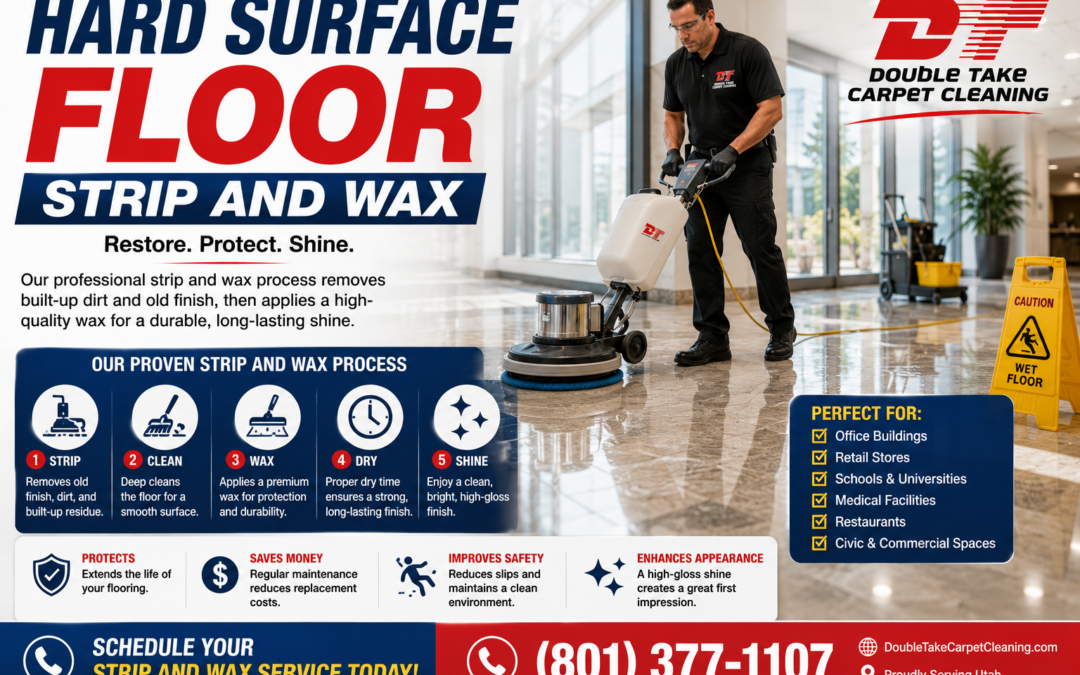
When is hard surface floor strip and wax necessary for commercial buildings? Hard surface floor strip and wax is necessary for commercial buildings when the existing wax layer becomes unevenly worn, discolored, or built up to the point where routine mopping no longer restores a clean appearance — typically every 12–18 months for VCT (vinyl composition tile) floors. The process chemically removes all old wax and sealant layers, then applies fresh coats to restore gloss, protection, and slip resistance.
Understanding VCT and Hard Surface Floor Care
Vinyl composition tile (VCT) is the most common hard surface flooring in commercial buildings — schools, hospitals, retail stores, and office buildings. VCT is durable and cost-effective, but it requires a maintenance cycle that includes stripping and refinishing because VCT is porous (without wax, it absorbs dirt, stains, and moisture), wax layers build up over time (after 6–8 coats of wax, the floor becomes yellowed and brittle), and topical wax protects the tile itself (worn wax exposes the tile to damage).
| Floor Type | Strip & Wax Frequency | Typical Coats Applied | Lifespan Maintained |
|---|---|---|---|
| VCT | 12–18 months | 4–6 coats | 20–30 years |
| Linoleum | 12–24 months | 3–5 coats | 25–40 years |
| Sheet Vinyl | 18–24 months | 3–4 coats | 15–25 years |
| Terrazzo | 24–36 months (burnish between) | 2–3 coats sealant | Lifetime |
| Sealed Concrete | 24–36 months (recoat only) | 2–4 coats | 10–15 years per coat system |
7 Signs Your Commercial Floor Needs a Strip and Wax
1. Yellowing or Discoloration — When wax oxidizes over time, it turns yellow or amber. This is most visible in high-traffic pathways and near windows where UV exposure accelerates oxidation.
2. Uneven Wear Patterns — Look for “traffic lanes” — paths where the wax is visibly thinner or missing. Entrances, hallways, and areas around workstations typically show wear first.
3. Wax Buildup in Edges and Corners — When floor machines push dirty wax into edges over multiple maintenance cycles, a dark ridge of built-up wax forms.
4. The Floor No Longer Shines After Buffing — If you burnish or buff and see no improvement, the wax layer has become too hard or contaminated to respond to mechanical polishing.
5. Black Marks Are Impossible to Remove — Worn wax allows scuff marks to bond directly to the tile.
6. Moisture Damage Around Edges — In kitchens, restrooms, or entryways, water can seep under worn wax and lift it from the tile.
7. Floor Finish Powdering — If you see white powder when buffing, the wax has become brittle and is breaking down.
The Strip and Wax Process: Step by Step
| Step | Action | Purpose |
|---|---|---|
| 1 | Clear and move furniture | Access the full floor area |
| 2 | Dry mop and dust | Remove loose debris |
| 3 | Apply chemical stripper | Break down existing wax layers |
| 4 | Agitate with floor machine | Loosen old wax for removal |
| 5 | Wet vacuum extraction | Remove dissolved wax and chemical residue |
| 6 | Rinse and neutralize | Remove remaining stripper so new wax adheres |
| 7 | Apply sealer (optional) | Base layer protection for porous tiles |
| 8 | Apply 4–6 coats of wax | Build protection and gloss |
| 9 | Buff between coats | Ensure even finish and proper bonding |
| 10 | Final burnish | Achieve desired gloss level |
| 11 | Cure time (8–24 hours) | Allow wax to harden before foot traffic |
DIY Strip and Wax vs Professional Service
| Factor | DIY In-House | Professional Service |
|---|---|---|
| Equipment cost | $3,000–$8,000 | Included |
| Labor time (10,000 sq ft) | 40–80 hours | 8–16 hours |
| Chemical cost | $400–$800 | Included |
| Risk | Water damage, delamination | Insured and guaranteed |
| Cost per sq ft | $0.35–$0.55 | $0.55–$0.90 |
| Downtime | 3–5 days | 1–2 days |
Cost of Strip and Wax for Commercial Buildings in Utah
| Area | Cost per sq ft (standard) | Cost per sq ft (heavy buildup) |
|---|---|---|
| Salt Lake Valley | $0.55–$0.75 | $0.80–$1.10 |
| Utah County | $0.50–$0.70 | $0.75–$1.00 |
| Sandy | $0.55–$0.80 | $0.80–$1.15 |
| Commercial (5,000+ sq ft) | $0.45–$0.65 | $0.70–$0.95 |
How to Extend Time Between Strip and Wax Cycles
- Daily dry mopping removes the abrasive grit that scratches wax — removes up to 85% of surface debris
- Auto-scrubbing with a neutral pH cleaner every 1–2 weeks restores gloss without damaging the coating
- Monthly burnishing with a high-speed machine (1,500+ RPM) polishes the wax and fills microscopic scratches
- Entry matting — 15–20 feet of walk-off matting reduces dirt tracked onto the floor by 70–80%
- Spot repair — spot-strip and recoat worn traffic lanes to extend the full-strip cycle to 24 months
Safety Considerations
Slip and fall liability is a major concern. Properly waxed floors improve safety: fresh wax fills microscopic pores creating a smoother surface, anti-slip aggregates can be mixed into the finish, and ANSI A137.1 standards recommend a coefficient of friction of 0.5 or greater. Improper stripping can leave chemical residue that creates a dangerously slick surface — professional stripping includes neutralization and multiple rinse passes.
Frequently Asked Questions
Can you strip and wax without moving all the furniture?
Heavy furniture must be moved for complete coverage. Professionals can work around larger fixed fixtures by edging up to them.
How long does the floor need to stay dry after waxing?
Most commercial-grade floor finishes require 8–12 hours before foot traffic and 24–48 hours before heavy traffic.
What happens if you don’t strip wax and just keep layering?
Over time, the wax becomes too thick (over 8–10 coats) and becomes brittle, yellow, and prone to delamination.
Can strip and wax be done after hours or on weekends?
Yes. Most commercial strip and wax is done evenings, overnight, or on weekends to minimize business disruption.
Does stripping damage VCT tiles?
Properly done, no. Leaving stripper on too long or using too aggressive of a pad can cause damage.
How many coats of wax should be applied?
Usually 4–6 coats. Four for low-traffic areas, six for high-traffic corridors and entryways.
Can you wax over sheet vinyl or LVT?
Some LVT and sheet vinyl products are factory-finished and should not be waxed. Check manufacturer specifications.
How do I choose between standard and high-gloss wax?
Standard gloss (20–40 gloss meter) for offices, schools, medical. High-gloss (60+) for retail, lobbies, hospitality.
What’s the difference between finish, wax, and sealer?
In commercial floor care, wax and finish are often used interchangeably. Sealer is applied before wax to penetrate and protect porous tiles.
Does strip and wax remove scratches from tile?
It removes scratches in the wax layer only. New wax fills minor scratches, giving the appearance of a fresh floor.
Is there a green/environmentally friendly option?
Yes. Low-VOC, biodegradable strippers and water-based floor finishes are available (Green Seal-certified).
Restore Your Commercial Floors
At Double Take Carpet Cleaning, we have 25+ years of experience serving Utah commercial buildings with hard surface floor strip and wax services. Our IICRC-certified team works after hours or on weekends to minimize disruption. Serving Sandy, Utah County, and the Salt Lake Valley. Call 801-377-1107 or visit dtcarpets.com for a free estimate.
