
Complete Pet Hair Removal Guide
Introduction
Pet hair on carpet is one of the most persistent frustrations for pet owners. Unlike dirt or spills that can be spot-cleaned, pet hair embeds itself deep into carpet fibers, clings to the backing, and seems to multiply no matter how often you vacuum. The problem goes beyond aesthetics — embedded pet hair traps dander, dirt, and odors, making your carpet look dull and feel rough underfoot.
Removing pet hair from carpet is not the same as removing general dirt. Pet hair has a natural barbed structure that grips carpet fibers, and the static electricity from friction makes it cling stubbornly. This guide covers every method, tool, and technique for effective pet hair removal, from quick daily maintenance to deep extraction.
For professional carpet cleaning and pet-hair removal throughout Utah, call Double Take Carpet Cleaning at 801-377-1107 or visit dtcarpets.com.
Understanding Pet Hair in Carpet
Why Pet Hair Is So Difficult to Remove
| Factor | Why It Matters | What It Means for Removal |
|---|---|---|
| Barbed hair structure | Pet hair has microscopic barbs that grip carpet fibers | Requires agitation, not just suction |
| Static electricity | Friction creates static that makes hair cling | Rubber tools neutralize static and attract hair |
| Hair length | Long hair wraps around carpet fibers | Needs cutting or specialized tools |
| Embedded depth | Hair gets pushed deep by foot traffic | Needs extraction from the base of fibers |
| Oils and dander | Hair carries oils that bond to carpet | Chemical treatment may be needed |
Pet Hair vs. Carpet Fiber Types
Different carpet fibers trap pet hair differently, and each requires a slightly different removal approach:
| Carpet Type | How Hair Behaves | Best Removal Method |
|---|---|---|
| Low-pile (Berber, loop) | Hair sits on surface, easily visible | Rubber squeegee, strong suction |
| Medium-pile (textured) | Hair embeds in middle of fibers | Carpet rake, brush roll vacuum |
| High-pile (plush, frieze) | Hair sinks deep, wraps around fibers | Multiple-direction vacuuming, rake |
| Loop pile (Berber style) | Hair catches in loops, hard to extract | Rubber brush, careful vacuuming |
Tools for Removing Pet Hair from Carpet
Tool Comparison
| Tool | Effectiveness | Cost | Best For |
|---|---|---|---|
| Rubber squeegee/broom | Excellent | $10-20 | All carpet types, quick whole-room removal |
| Carpet rake | Excellent | $20-40 | Medium to high-pile carpet, deep extraction |
| Pet-specific vacuum | Very Good | $150-600 | Daily maintenance, whole-home |
| Rubber brush | Very Good | $10-15 | Spot removal, stairs, upholstery |
| Squeegee mop | Good | $15-25 | Low-pile carpet, tile-to-carpet transitions |
| Lint roller (large) | Moderate | $5-10 | Small areas, final touch |
| Damp sponge/microfiber | Moderate | $5 | Small spots, edges, baseboards |
The Best Tool: Rubber Squeegee
A rubber squeegee (the kind used for windows) is surprisingly the most effective single tool for pet hair removal from carpet. Here’s why:
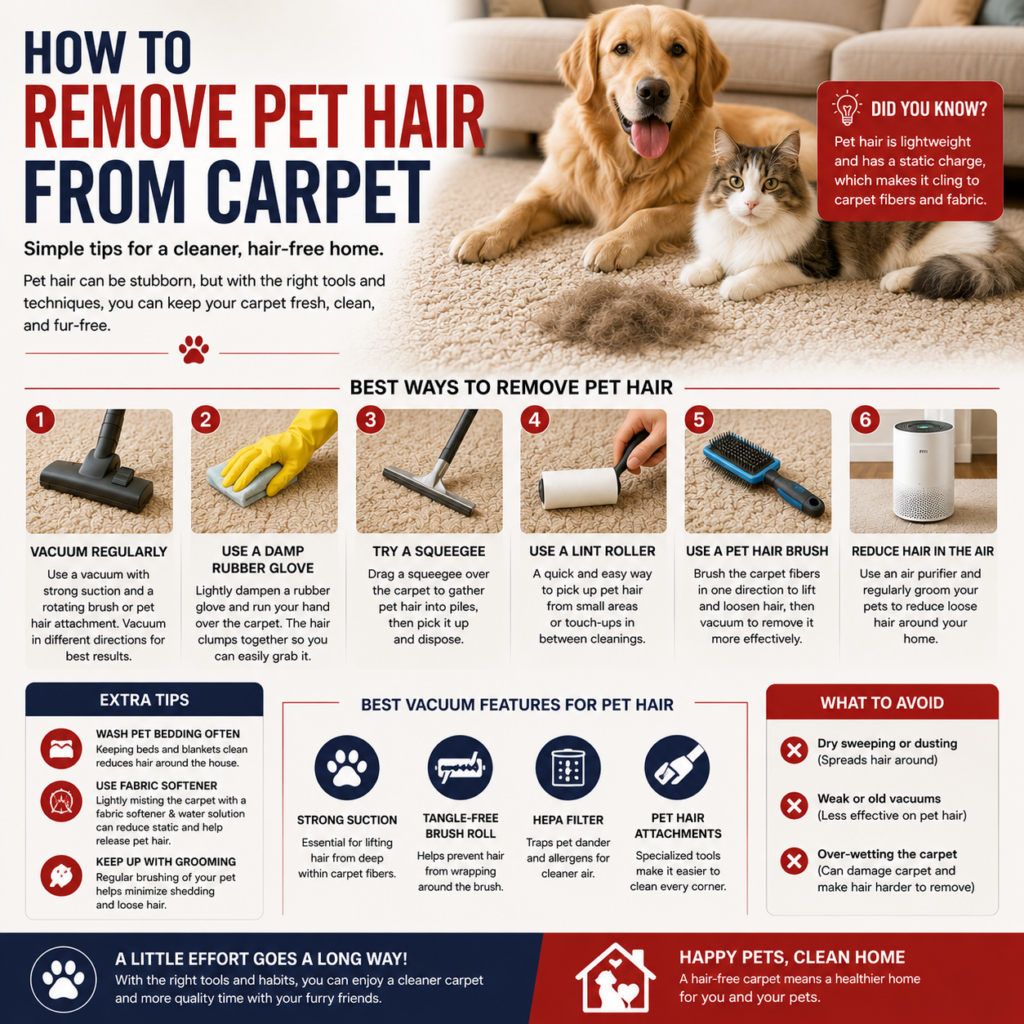
1. Static electricity — rubber creates static that attracts pet hair, pulling it out of fibers
2. Gentle on carpet — doesn’t damage fibers like some brushes
3. Fast — covers large areas quickly
4. Multi-surface — works on carpet, rugs, upholstery, and hard floors
Step-by-Step Pet Hair Removal Methods
Method 1: Rubber Squeegee (Fastest Whole-Room Method)
What you need:
– Rubber squeegee (12-18 inch width)
– Dustpan or vacuum
– Spray bottle with water (optional, for static)
Steps:
1. Spray carpet with a light mist of water (optional — reduces static)
2. Starting at the farthest corner, push the squeegee in long, straight strokes
3. Work in one direction across the entire room
4. Collect the hair piles with a dustpan or vacuum
5. Repeat in a perpendicular direction for remaining hair
6. Vacuum normally to pick up any loosened hair
Daily and Weekly Pet Hair Removal Routines
Daily Routine (3-5 Minutes)
- Quick rubber squeegee pass over high-traffic pet areas — 1 minute
- Spot vacuum the piles of hair the squeegee gathered — 1 minute
- Check pet beds and favorite spots — 1 minute
- Wipe down baseboards with a damp microfiber cloth — 1 minute
Weekly Routine (15-20 Minutes)
- Rubber squeegee entire carpet — push hair into piles in each room
- Vacuum slowly using a pet-specific vacuum or one with a brush roll
- Use a crevice tool along baseboards, under furniture, and in corners
- Vacuum in multiple directions — north-south, east-west, diagonal
- Empty the vacuum bin — pet hair fills bins faster than dirt
- Clean the vacuum brush roll — remove wrapped hair
Pet Hair Removal by Room
- Under furniture — use a crevice tool or remove furniture every 2-3 weeks
- Along baseboards — hair accumulates where walls meet carpet
- In corners — use the crevice tool in a scraping motion
- On stairs — use a rubber brush or brush roll vacuum attachment
Vacuum Maintenance for Pet Hair
| Task | Why It Matters | Frequency |
|---|---|---|
| Clean brush roll | Hair wraps around it, reducing agitation | Weekly |
| Empty bin or replace bag | Reduced suction = poor hair pickup | Every use |
| Check belt tension | Loose belts don’t spin the brush roll | Monthly |
| Clean filters | Clogged filters reduce airflow | Monthly |
Preventing Pet Hair Accumulation
| Strategy | Effectiveness | Effort |
|---|---|---|
| Brush pets outdoors | High | Low |
| Use a deshedding tool | Very High | Moderate |
| Wash pet bedding weekly | High | Moderate |
| Use a robot vacuum | Moderate | Low |
| Place washable rugs | High | Low |
Frequently Asked Questions
Q1: What is the best tool to remove pet hair from carpet?
A rubber squeegee is the most effective single tool. It creates static that attracts pet hair, pulling it from deep in carpet fibers.
Q2: How do I get pet hair out of car carpet?
Use a rubber squeegee or a pumice stone (dryer bar). The stone’s rough surface grabs hair. Vacuum afterward.
Q3: Does baking soda remove pet hair from carpet?
Baking soda doesn’t directly remove hair, but it helps by loosening hair from fibers and reducing static. Sprinkle, let sit 15 minutes, then vacuum thoroughly.
Q4: How do I get pet hair out of Berber carpet?
Use a rubber squeegee or a rubber brush. The looped fibers of Berber trap hair — avoid aggressive brushing that could snag loops.
Q5: What vacuum is best for pet hair?
Look for strong suction, a brush roll that can be easily cleaned, a HEPA filter, and a large capacity bin. Brands like Dyson, Shark, and Miele have excellent pet-specific models.
Q6: How often should I vacuum pet hair?
Daily in rooms where pets spend the most time. Every other day in other carpeted rooms.
Q7: Can a carpet rake damage carpet?
Used correctly, no. Avoid aggressive pressure and use it only on cut-pile carpet.
Q8: How do I get pet hair out of carpet without a vacuum?
Use a rubber squeegee or a damp sponge. The squeegee gathers hair into piles that can be swept up.
Q9: Why does my vacuum leave pet hair behind?
The most common reasons: full bin/bag, dirty filter, worn brush roll, or wrapped hair on the brush roll.
Q10: How do I remove pet hair from carpet edges?
Use a crevice tool attachment. For stubborn edges, wrap a rubber band around the crevice tool — the rubber creates static that attracts hair.
Q11: Is there a spray that removes pet hair from carpet?
Anti-static sprays can help by reducing the static cling that holds hair to fibers.
Q12: How do I remove pet hair from stairs?
Use a handheld vacuum with a brush roll, or a rubber brush. Work from the top down.
Q13: Does professional carpet cleaning remove pet hair?
Yes. Professional hot water extraction flushes embedded pet hair and dander out of carpet fibers.
Q14: How do I prevent pet hair from embedding in carpet?
Brush your pets daily outdoors, use a robot vacuum on a schedule, wash pet bedding weekly.
Q15: Can pet hair damage my vacuum?
Yes. Pet hair wraps around brush rolls, clogs filters, and fills bins quickly.
Pet Hair Removal Schedule by Household
| Household Type | Vacuum Frequency | Professional Cleaning |
|---|---|---|
| 1 cat, low shedding | 2-3x per week | Every 6 months |
| 1 dog, moderate shedding | Daily | Every 4-6 months |
| 2+ pets, heavy shedding | Daily + spot vacuuming | Every 3-4 months |
For professional pet hair removal and deep carpet cleaning, contact Double Take Carpet Cleaning at 801-377-1107 or visit dtcarpets.com. We serve Utah County, Salt Lake County, and throughout Utah.
