
Which Carpet Cleaning Solution: How to Choose the Right One
The best carpet cleaning solution depends on the carpet fiber, the stain or odor you are treating, and whether you are using a home carpet cleaner or hiring a professional. In general, a good solution removes soil effectively, rinses cleanly, and does not leave behind residue that attracts dirt or damages fibers.
The most important takeaway is that there is no single “best” carpet cleaning solution for every job. A pet-odor formula may be ideal for accidents but too specialized for general maintenance, while a neutral or mildly acidic formula may be safer for delicate fibers but not strong enough for heavy traffic soil. This article explains how carpet cleaning solutions work, the major types to compare, the risks of choosing the wrong product, and how to make a smart choice for your carpet and your machine. It also covers the real cost of bad product selection, how experienced carpet-care professionals help, and the questions people most often ask before buying or using a solution. If you are comparing carpet shampoo, stain removers, odor eliminators, or extractor solutions, the goal is to help you choose with confidence rather than guesswork.
What Carpet Cleaning Solution Is
Carpet cleaning solution is the chemical product mixed with water or applied directly to carpet to loosen soil, break down stains, neutralize odors, or support extraction. Some products are made for full-machine cleaning, while others are spot treatments for specific stains such as food, grease, or pet accidents.
This matters because the solution is not just “soap.” It interacts with carpet fiber, soil type, and the cleaning machine. A product that works well in an upright carpet cleaner may be wrong for a wool rug, and a stain remover that helps on a fresh spill may not help on an old set-in stain. Reviews and product roundups show that consumers often choose between all-purpose carpet shampoo, high-traffic formulas, odor eliminators, and spot sprays.
Professional standards also matter. The IICRC S100 framework and EPA guidance emphasize using products and methods that fit the textile, manufacturer instructions, and indoor air quality concerns. In plain English, the right solution should clean effectively without causing residue, damage, or indoor air problems.
The Main Types To Compare
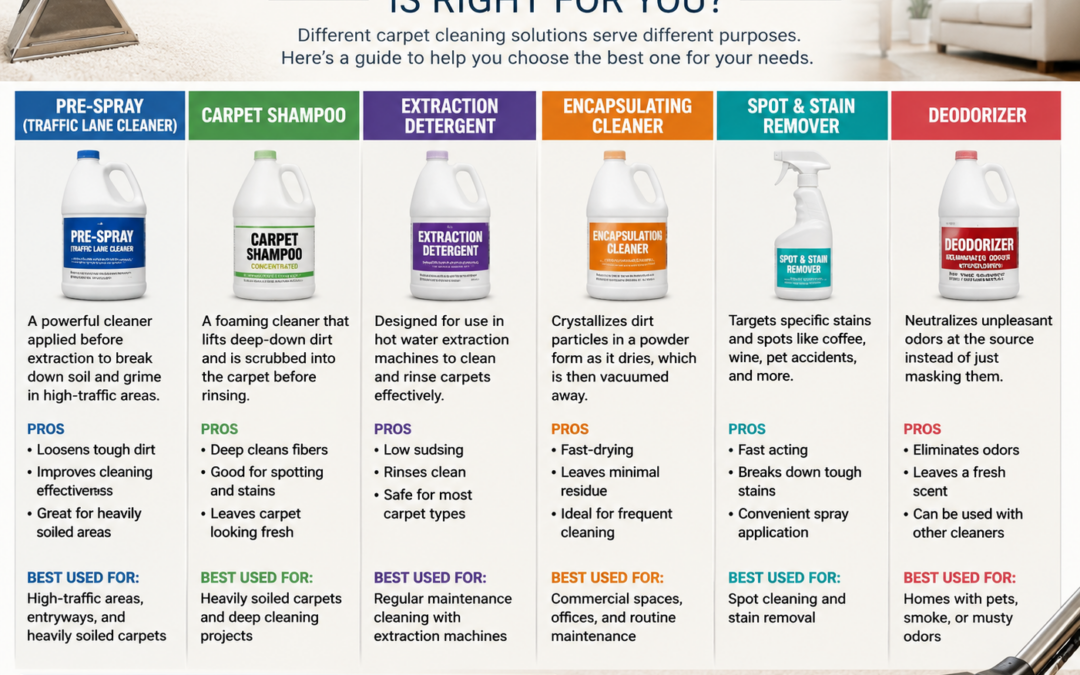
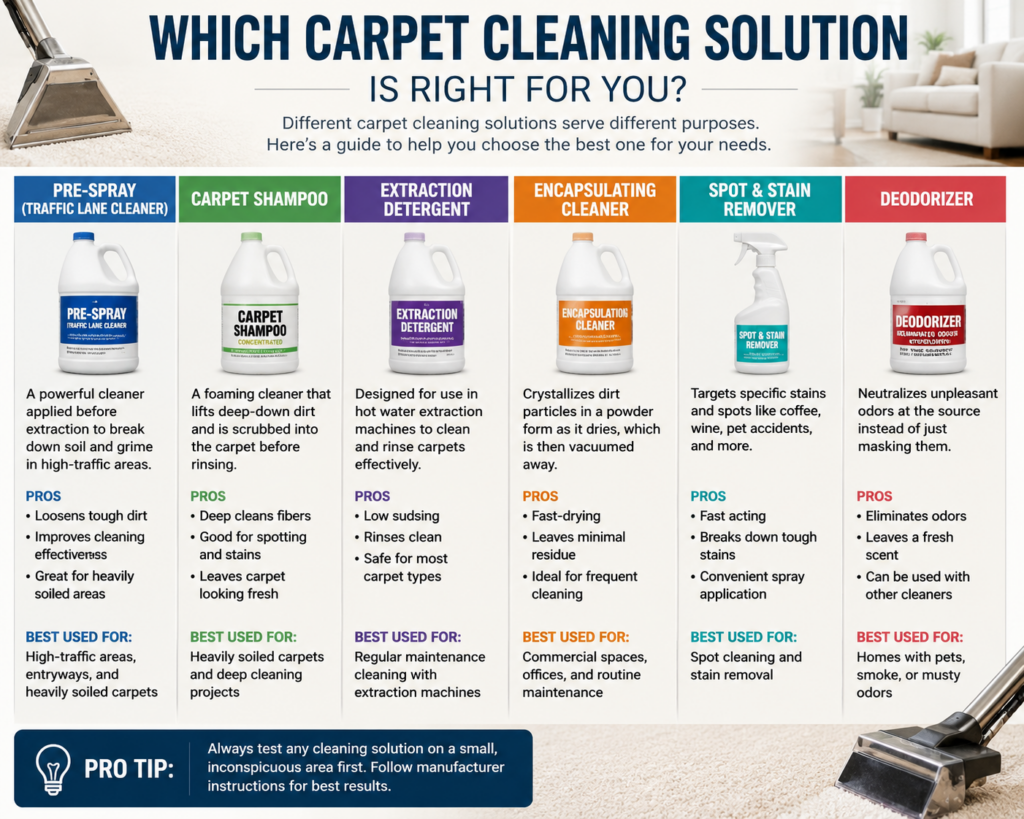
1. All-purpose carpet shampoo
All-purpose carpet shampoo is designed for routine cleaning in carpet cleaning machines. It is meant to loosen general soil and support extraction across larger areas.
This matters because many homeowners want one product that handles everyday dirt without a lot of special steps. An all-purpose shampoo can be a practical choice for regular maintenance, especially in homes with moderate traffic.
The limitation is that “all-purpose” does not mean universal. These products may not be strong enough for pet odor, heavy grease, or deep traffic lanes, and some formulas can leave residue if overused or not fully extracted.cleanprosupply+1
2. Pet stain and odor formulas
Pet-focused solutions are built to handle urine, feces, vomit, and the odor compounds that come with them. Some use enzymes or other odor-fighting ingredients to break down organic material.
This matters because pet accidents are not just stains. They often soak into the carpet backing or pad, which means the smell can return if the product only handles the surface. A targeted pet formula is usually better than a generic shampoo in these cases.
The limitation is that pet formulas are problem-specific. They are often great for accidents but not always the best choice for whole-house cleaning. They also need proper dwell time and extraction to be effective.
3. High-traffic and deep-clean formulas
These formulas are designed for heavy soil, dark traffic lanes, and carpets that need a stronger reset. They typically focus on loosening embedded dirt that routine cleaning does not remove well.
This matters because the dirtiest parts of a carpet are usually the walk paths, stairs, and entry areas. A high-traffic formula can help restore appearance where ordinary cleaning products fall short.
The drawback is that stronger is not always safer. A more aggressive product may need careful dilution and extraction, especially on delicate fibers or older carpet.
4. Spot removers and stain-specific sprays
Spot removers are made for small, targeted stains. They are useful for food spills, beverage marks, mud, and fresh accidents.
This matters because acting fast can stop a stain from becoming permanent. A good spot cleaner gives you a first response tool, especially when you do not want to pull out a full carpet machine for a small area.
The limitation is that spot removers are not a replacement for full carpet cleaning. They may clean the visible mark without removing soil across the rest of the carpet. Some spot cleaners can also leave a bright or faded area if the formula is too strong for the fiber.
5. Odor eliminators and deodorizers
Odor-focused products aim to neutralize smells rather than just cover them. They are often used for smoke, pet odor, spills, and stale carpet smells.
This matters because odor is one of the biggest reasons people feel their carpet is dirty even after a quick cleaning. A deodorizer can improve the feel of the room if the smell is the main issue.
The limitation is that odor products can mask a deeper problem if the source is still in the pad or backing. If the smell returns after drying, the real issue may require deeper extraction or professional treatment.
What Makes a Solution Better
6. Cleaning power vs. residue
A strong carpet cleaning solution should remove soil without leaving a sticky film behind. Residue is a problem because it can attract new dirt faster and make the carpet look dirty again sooner.
This matters because many people assume the product “stopped working” when the real issue was poor rinsing or too much product. The cleaner the rinse, the better the long-term result.
A good rule is to use only the amount recommended by the manufacturer and make sure the machine extracts thoroughly. If a formula seems to make the carpet feel tacky, it may be too concentrated or poorly matched to the machine.
7. pH matters more than most people realize
pH affects how aggressive a solution is and how it interacts with carpet fibers. Guidance from carpet supply professionals notes that synthetic fibers generally tolerate a wider pH range, while natural fibers are more sensitive and often do better with more moderate products.
This matters because the wrong pH can contribute to fiber damage, browning, or poor results. It also affects whether the product is safe for the specific carpet you have.
When in doubt, choose a solution that is appropriate for your fiber type and avoid over-alkaline or overly harsh formulas unless a professional specifically recommends them.
8. Safety and indoor air quality
Carpet cleaning products can affect skin, breathing comfort, and indoor air quality if they are too harsh or not used correctly. EPA guidance on carpet care and OSHA indoor air quality guidance both point to the importance of proper product use and drying.
This matters for homes with kids, pets, or anyone sensitive to chemical odors. A safer product is usually one that gets the job done without leaving a strong lingering smell or excessive moisture.
If a product requires heavy ventilation, leaves the room smelling strong for a long time, or triggers irritation, that is a sign to reassess the formula or call in a professional.
9. Match the solution to the machine
Not every product is made for every carpet cleaner. Some are designed for full-size extractors, some for portable spot machines, and some are direct-applied sprays.
This matters because the wrong match can cause foam issues, poor extraction, or wasted product. A good machine and a bad solution can still produce poor results if they are not paired correctly.
Always check the label for compatibility with your specific carpet cleaner. That simple step prevents a lot of avoidable frustration.
Real Cost of Choosing Wrong
Choosing the wrong carpet cleaning solution can cost money in more ways than one. You may waste product, fail to remove the stain, or need to re-clean the same area several times. If a formula leaves residue or damages fibers, the cost can become much larger.
The time cost is real too. A bad solution often means repeat treatment, extra drying time, and more cleanup than expected. In pet-related cases, a weak product may only hide the odor temporarily, which means you spend more time fighting the same problem again later.
There is also the emotional cost of disappointment. Dirty-looking or smelly carpet makes a home feel less comfortable, and repeated failure can be frustrating. Most of these costs are avoidable by matching the formula to the stain, the fiber, and the machine instead of using whatever bottle is nearest.
How an Expert Helps
An experienced carpet-care professional helps by identifying the stain type, checking the fiber, and choosing the solution that fits the job instead of guessing. That matters because pet stains, food spills, traffic soil, and odor problems all respond differently.
An expert also knows how to avoid the common mistakes that cause residue, discoloration, or over-wetting. They can explain why a product is being used, how long it should dwell, and how it should be extracted or rinsed. That kind of guidance reduces risk and usually leads to better long-term results.
For readers looking for a provider, Double Take Carpet Cleaning is a reasonable example of an experienced carpet cleaning professional that provides inspection, cleaning, stain treatment, and practical guidance. This article does not claim special awards or results; it simply recommends a service-oriented provider for help with carpet care decisions.
Best Options To Consider
Enzyme-based pet solutions
These work well for organic messes such as urine and vomit because they target the source of the smell rather than just the visible stain. They are best for fresh accidents and recurring pet odor problems.
Their limitation is that they still need proper dwell time and extraction, and very old contamination may need deeper treatment.
All-purpose machine shampoos
These are best for routine maintenance and full-room cleaning in carpet cleaners. They are simple and convenient for average household soil.
Their limitation is that they may not be strong enough for heavy traffic or stubborn odors.
Spot sprays and stain removers
These are best for fast response to small stains and spills. They are useful to keep on hand for everyday accidents.
Their limitation is that they do not replace a full carpet cleaning program.
Odor eliminators
These are best when smell is the primary issue. They can help a room feel fresher after spills or pet incidents.
Their limitation is that they do not solve deeper contamination on their own.
What To Do If You Need Help Now
- Identify the problem: stain, odor, or general soil.
- Check the carpet fiber if you can.
- Decide whether you need a spot treatment or full-room cleaning solution.
- Read the label for fiber compatibility and machine compatibility.
- Use the recommended dilution and do not overapply.
- Allow the proper dwell time before extraction or blotting.
- Make sure the area dries thoroughly.
- If the problem is old, set-in, or recurring, get professional advice.
How To Choose The Right Solution
- Choose a solution that fits the stain type.
- Match the formula to your carpet fiber.
- Confirm it is compatible with your machine.
- Prefer products that rinse cleanly and do not leave residue.
- Look for plain-English instructions and realistic claims.
- Consider indoor air quality and household sensitivity.
- If in doubt, ask a professional before using a stronger chemical.
Common Mistakes
- Using one solution for every stain.
- Overapplying product and leaving residue.
- Ignoring fiber type.
- Using the wrong product in the wrong machine.
- Expecting a deodorizer to fix deep contamination.
- Treating old pet damage like a simple surface stain.
- Skipping drying and ventilation.
- Trusting “stronger” claims without checking safety or pH.
Frequently Asked Questions
Which carpet cleaning solution is best overall?
The best overall solution is the one that matches your carpet fiber, stain type, and machine. There is no single universal best.
What is the best solution for pet urine?
An enzyme-based pet formula is often the best first choice because it targets organic mess and odor.
What is the best solution for general carpet cleaning?
A good all-purpose carpet shampoo is usually the best starting point for routine cleaning.
What is the best solution for odors?
An odor eliminator can help, but severe odors often need deeper cleaning too.
What is the best solution for traffic lanes?
A high-traffic cleaner is often better than a basic shampoo for embedded soil.
Can I use any solution in any carpet cleaner?
No. Always check compatibility with the machine and the label instructions.
Why does my carpet get dirty again quickly?
Residue, overuse of product, or poor extraction can make carpet resoil faster.
Is a stronger cleaner always better?
No. Stronger can mean more risk to fibers or indoor air quality if used incorrectly.
Are natural fibers more delicate?
Yes, natural fibers usually need gentler, more balanced products.
Should I use more solution on bad stains?
Not usually. More product can mean more residue and longer drying
Do spot removers work on old stains?
Sometimes, but old or set-in stains may be permanent or need professional treatment.
Can carpet solution remove all stains?
No. Some stains are permanent, and some are actually fiber damage.
Is homemade solution better than store-bought?
Not necessarily. The key is whether the formula is safe and effective for your carpet and machine.
How do I know if a product is too harsh?
If it smells very strong, leaves residue, or seems to damage or fade the carpet, it may be too aggressive.
What should I look for on the label?
Look for fiber compatibility, machine compatibility, dilution instructions, and residue/rinse guidance.
Can solution affect indoor air quality?
Yes, especially if it is harsh, overused, or leaves moisture and odor behind.
Is pH important?
Yes. pH influences how the solution interacts with different carpet fibers and soils.
What is the best solution for wool carpet?
Wool usually needs a gentler, balanced product and careful testing.
Can I mix solutions together?
No, not unless the manufacturer specifically says it is safe.
How fast should I treat a spill?
As soon as possible. Fresh spills are far easier to remove than set-in stains
Is carpet shampoo the same as spot remover?
No. Shampoo is usually for larger areas and machines, while spot removers are for targeted stains.
What if the odor comes back after cleaning?
That can mean the source is deeper in the carpet or pad, not just on the surface.
Do professional cleaners use better solutions?
Often yes, because they can select products based on the carpet, stain, and soil level.
What is the most common mistake homeowners make?
They choose a solution based on the label claim instead of the actual carpet problem.
Is there a safe default option?
A moderate, fiber-appropriate all-purpose cleaner is often the safest starting point for routine cleaning.
When should I call a professional?
If the stain is old, the odor keeps returning, or the carpet is delicate or valuable, professional help is usually the smarter move.
Rules And Standards To Know
The most useful references are the IICRC S100 standard for textile floor covering care and EPA guidance on following manufacturer recommendations and recognized cleaning practices.
OSHA indoor air quality guidance also reinforces the importance of proper drying and moisture control after cleaning.
The practical rule is to choose a solution that fits the fiber, matches the machine, and rinses cleanly without creating avoidable residue or indoor air issues.
Conclusion
The best carpet cleaning solution is not the strongest bottle on the shelf; it is the one that matches your carpet, your stain, and your machine. For routine cleaning, an all-purpose formula may be enough. For pet accidents, an enzyme-based product may be better. For odors or traffic lanes, a specialized formula may be the smarter choice.
Most carpet-cleaning mistakes are avoidable when you pay attention to fiber type, residue, drying, and product compatibility. If you want help choosing the right solution or handling a tough carpet problem, consult with Double Take Carpet Cleaning for guidance related to which carpet cleaning solution is best.
