
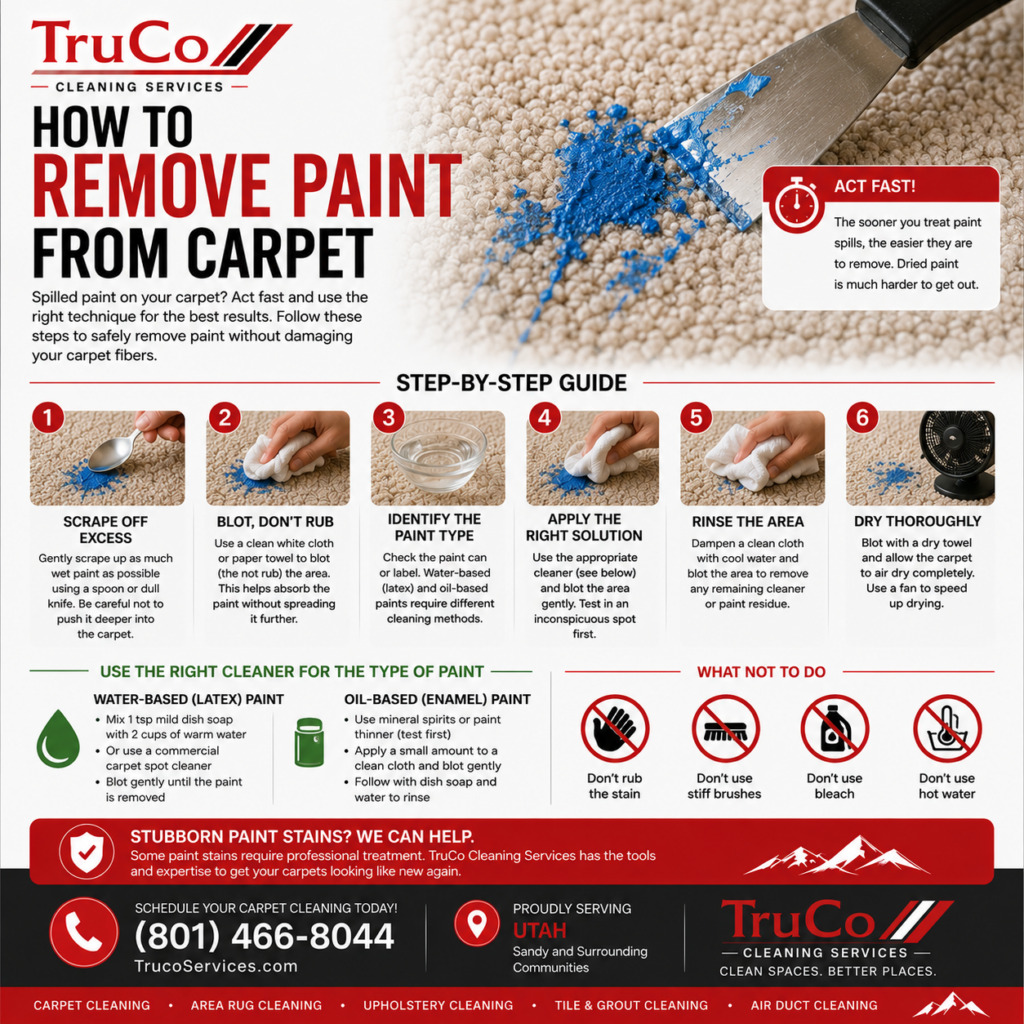
The best way to remove paint from carpet depends entirely on whether the paint is water-based (latex) or oil-based — and whether it is still wet or has already dried. For wet latex paint, immediate blotting with cold water can remove nearly 100% of the paint. For dried latex, rubbing alcohol or a professional paint remover is needed. For oil-based paint, solvent is required and the success rate drops significantly. The key factor in all cases is speed — a wet paint spill has a 90%+ removal rate, while dried paint may be only 50-70% removable.
Identify the Paint Type
| Paint Type | Base | Dries By | Cleanup Solvent | Success Rate (Fresh) | Success Rate (Dried) |
|---|---|---|---|---|---|
| Latex (water-based) | Water | Evaporation | Water, soap, rubbing alcohol | 95-100% | 70-90% |
| Acrylic (water-based) | Water | Evaporation | Water, soap, rubbing alcohol | 90-95% | 60-80% |
| Oil-based (alkyd) | Mineral spirits | Oxidation | Mineral spirits, turpentine | 70-80% | 30-50% |
| Enamel | Oil or water | Varies | Depends on base | 60-80% | 30-50% |
| Spray paint | Varies | Fast evaporation | Acetone (test first) | 50-70% | 20-40% |
| Fabric paint | Water or acrylic | Curing | Difficult — often permanent | 40-60% | 10-30% |
How to Test Which Paint Type
- Read the label — Look for “water-based,” “latex,” “acrylic” vs. “oil-based,” “alkyd”
- Rub with rubbing alcohol — If paint softens, it is latex. If it does not, it may be oil-based
- Check the clean-up instructions — “Soap and water” = water-based. “Mineral spirits” = oil-based
Wet Paint: Immediate Action
Wet Latex Paint (Best Case)
| Step | Action | Time |
|---|---|---|
| 1 | Blot with clean cloth — do not rub | Immediately |
| 2 | Spray with cold water | Within 1 minute |
| 3 | Blot again with clean cloth | 1-2 minutes |
| 4 | Apply mild dish soap + water | 2-3 minutes |
| 5 | Blot until no color transfers | 3-5 minutes |
| 6 | Rinse with cold water, blot dry | 5-10 minutes |
Success rate: 95-100%
Wet Oil-Based Paint (Difficult)
| Step | Action | Caution |
|---|---|---|
| 1 | Blot with cloth — do not spread | Wear gloves |
| 2 | Apply mineral spirits to a cloth | Test on inconspicuous area |
| 3 | Blot — do not pour solvent on carpet | Solvent can damage backing |
| 4 | Repeat with clean cloth sections | Replaces soiled cloth |
| 5 | Rinse with dish soap + water | Removes solvent residue |
| 6 | Blot dry |
Success rate: 70-80%
Dried Paint: Professional Approach
Dried Latex Paint
Once latex paint has dried, water alone will not remove it. The paint has formed a plastic film around carpet fibers.
Method 1: Rubbing Alcohol (Most Effective)
| Step | Action | Time |
|---|---|---|
| 1 | Scrape off excess paint with a dull knife | 1-2 minutes |
| 2 | Apply 90% rubbing alcohol to a cloth | Do not pour directly |
| 3 | Dab the paint — it will soften | 5-10 minutes |
| 4 | Gently scrape softened paint | Gently — do not damage fibers |
| 5 | Repeat alcohol application | May need 3-5 cycles |
| 6 | Rinse with dish soap + water | 2-3 minutes |
| 7 | Blot dry |
Method 2: Commercial Paint Remover (Professional Grade)
Professional carpet cleaners use solvent-based paint removers specifically formulated for carpet. These are more effective than household products but require expertise to use without damaging the carpet backing.
Dried Oil-Based Paint
Oil-based paint that has dried is very difficult to remove. The paint has oxidized and bonded to the fibers.
| Method | Effectiveness | Risk |
|---|---|---|
| Mineral spirits | 40-50% | Can damage carpet backing |
| Turpentine | 30-40% | Strong fumes, slow |
| Commercial solvent | 50-70% | Best option, professional only |
| Paint thinner | 30-50% | May discolor fibers |
| Heat gun + scraping | 20-30% | High risk of fiber damage |
For dried oil-based paint, professional treatment is strongly recommended.
Professional Paint Removal Process
When paint has dried or is oil-based, professional carpet cleaners follow a multi-step process:
Step 1: Assessment
Identify the paint type, how long it has been there, and the carpet fiber type. This determines which solvent to use.
Step 2: Solvent Application
The technician applies a professional-grade solvent specifically matched to the paint type. For latex, a citrus-based solvent. For oil-based, a hydrocarbon solvent.
Step 3: Dwell Time
The solvent is allowed to sit for 5-15 minutes to soften the paint.
Step 4: Mechanical Removal
Using a spatula, tweezers, or scraping tool, the technician gently lifts the softened paint from the fibers.
Step 5: Hot Water Extraction
A truck-mounted HWE system at 210°F flushes out any remaining solvent and paint residue. The high temperature helps dissolve any remaining particles.
Step 6: Inspection
The technician checks for paint residue. Multiple passes may be needed.
Paint Removal by Carpet Fiber
| Carpet Fiber | Latex Paint (Wet) | Latex Paint (Dried) | Oil Paint (Wet) | Oil Paint (Dried) |
|---|---|---|---|---|
| Nylon | 100% | 85% | 80% | 50% |
| Polyester | 100% | 80% | 75% | 45% |
| Olefin | 95% | 70% | 60% | 30% |
| Wool | 90% (gentle) | 60% (caution) | 50% (caution) | 20% (caution) |
| Triexta | 100% | 90% | 85% | 55% |
What NOT to Do
| Method | Why It Fails | Risk |
|---|---|---|
| Scrape with sharp knife | Cuts carpet fibers | Fiber damage |
| Use bleach | Does not dissolve paint | Bleach stain |
| Use nail polish remover (acetone) | Can melt synthetic fibers | Fiber damage |
| Pour paint thinner directly | Soaks into backing | Backing damage |
| Use hot water on latex | Sets the paint | Permanently bonds paint |
| Rub vigorously | Spreads paint wider | Larger stain |
Paint Cleanup: Tools to Have Ready
| Tool | Purpose |
|---|---|
| Clean white cloths | Blotting (no printed paper towels) |
| Dull butter knife | Scraping dried paint |
| Rubbing alcohol (90%) | Dissolving dried latex |
| Dish soap (Dawn) | Removing solvent residue |
| Mineral spirits | Oil-based paint (use sparingly) |
| Spray bottle with cold water | Diluting wet latex |
| Shop vacuum | Extracting if large amount |
| Professional cleaner’s number | When all else fails |
Frequently Asked Questions
Q: Can dried paint be removed from carpet?
A: Yes — latex paint can usually be removed with rubbing alcohol. Oil-based paint is much harder and may leave a shadow.
Q: Does vinegar remove paint from carpet?
A: No. Vinegar does not dissolve either latex or oil-based paint. Use rubbing alcohol for latex, mineral spirits for oil-based.
Q: Can paint thinner be used on carpet?
A: With extreme caution. Apply to a cloth, not directly to carpet. Rinse thoroughly with soap and water afterward.
Q: How do you get latex paint out of carpet after it has dried?
A: Apply 90% rubbing alcohol to a cloth, dab the paint until it softens, then gently scrape. Repeat until all paint is removed.
Q: Will paint removal damage my carpet?
A: Not if done correctly. Aggressive scraping or harsh solvents can damage fibers. Gentle, patient work preserves the carpet.
Q: Can professional carpet cleaners remove paint?
A: Yes — and they have professional-grade solvents and equipment that are much more effective than household products.
Q: How much does professional paint removal cost?
A: Typically $75-150 per spot, depending on size, paint type, and how long it has been there.
Q: Is spray paint harder to remove than regular paint?
A: Yes — spray paint dries almost instantly and the propellant can spread the paint into a fine mist that bonds to fibers.
Q: Can you remove paint from wool carpet?
A: With great care. Wool is sensitive to solvents. Rubbing alcohol can be used sparingly. Professional treatment is strongly recommended for wool.
Q: What if the paint has been on the carpet for years?
A: Removal becomes much harder. Professional-grade solvents and multiple treatments may be needed. Some residual staining may remain.
Don’t Let a Paint Spill Ruin Your Carpet
Paint spills on carpet are stressful, but most can be resolved — especially if caught early. If your paint spill has dried or if you are dealing with oil-based paint, call a professional before making it worse with harsh chemicals. Double Take Carpet Cleaning has removed paint from countless carpets over 25+ years serving Utah County and Salt Lake Valley. IICRC-certified, truck-mounted HWE, 99% satisfaction guarantee. Call 801-377-1107 or visit https://dtcarpets.com.
