
How do you get mud out of carpet like a pro?
The professional method for removing mud from carpet starts with one counterintuitive rule: let it dry completely. The #1 mistake homeowners make is trying to clean wet mud. When you rub or scrub wet mud, it works deeper into carpet fibers and spreads across a wider area, turning a small spot into a large, embedded stain. Once the mud is dry, it turns into dry dust that vacuums right up — no scrubbing needed. For Utah’s red clay mud, this process is especially important because clay particles are extremely fine and embed deeply when wet.
The complete professional mud removal process
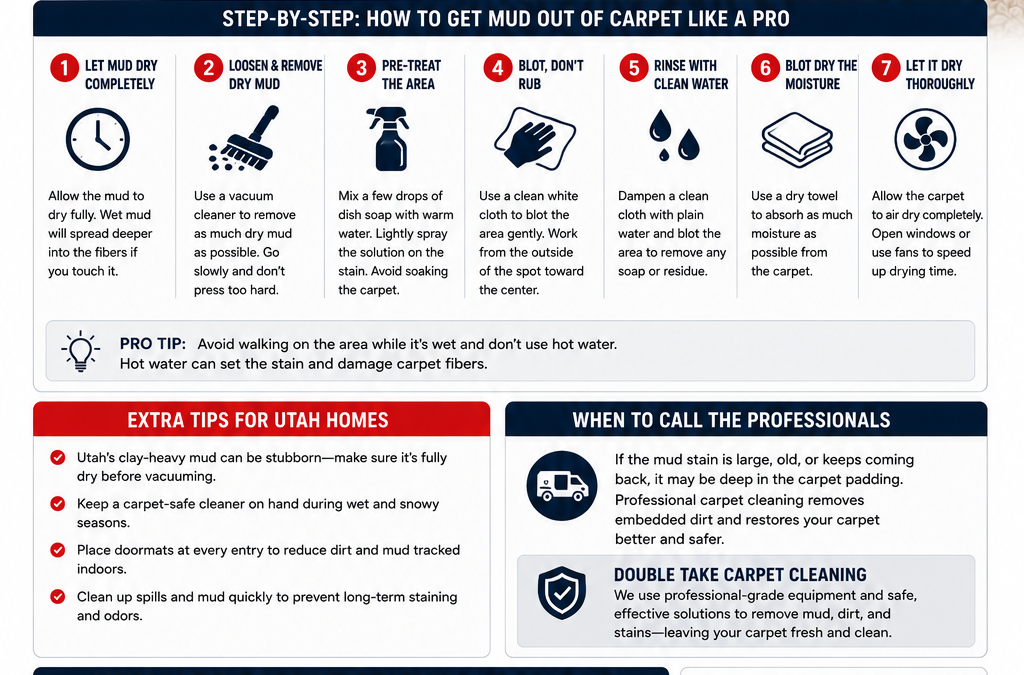
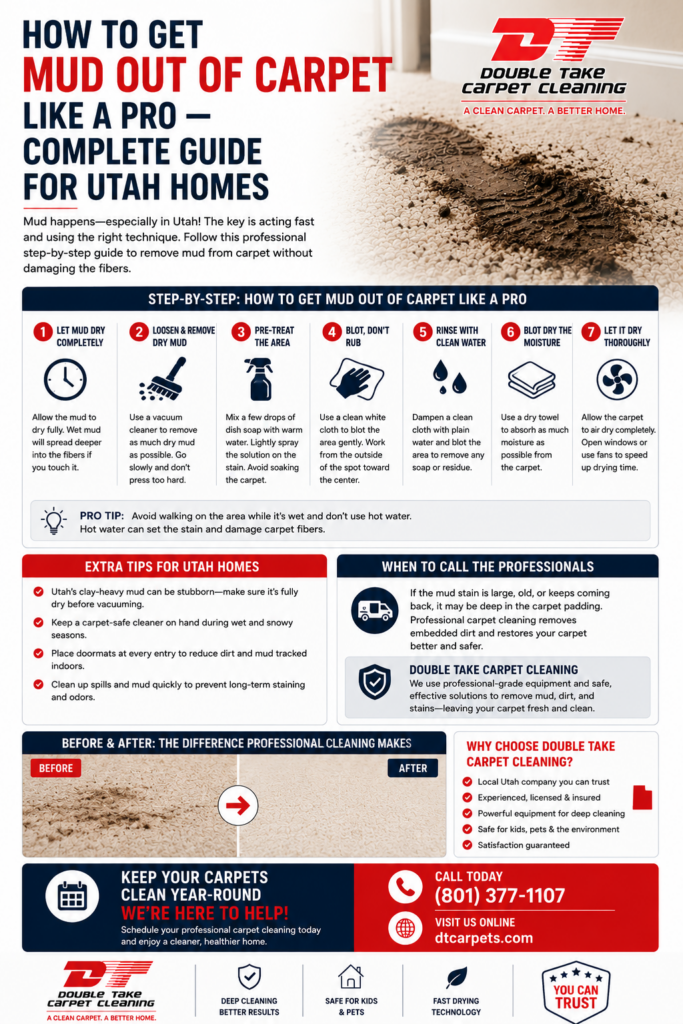
Step 1: Let the mud dry completely
This is the most important step. Do NOT touch wet mud. Close the door to the room or place furniture over the spot to prevent foot traffic. If the mud is thick, you can speed drying with:
- A fan pointed at the spot
- A hairdryer on cool/low setting (not hot)
- Time — typically 2-6 hours depending on thickness
Step 2: Vacuum up the dry mud
Once the mud is dry and crumbly, use a vacuum with strong suction. Run the vacuum over the spot in multiple directions to lift all the dried particles. A brush attachment can help loosen mud from carpet fibers.
Step 3: Apply a neutral carpet cleaner
If a residual stain remains after vacuuming, apply a neutral pH carpet cleaning solution. Spray lightly, allow 3-5 minutes to dwell, then blot with a clean white cloth. Do not scrub.
Step 4: Hot water rinse and extraction
Spray clean water onto the spot and extract with a wet/dry vacuum or professional extractor. Repeat until the water runs clear.
Step 5: Dry thoroughly
Place fans on the area and avoid walking on it until fully dry (4-8 hours). Walking on damp carpet can push remaining particles deeper.
Why Utah’s red clay mud is different
Utah’s soil contains high concentrations of iron oxide (red clay) particles that are microscopic in size and abrasive to carpet fibers. When wet clay is rubbed into carpet, these particles:
- Embed deep into fiber roots where normal vacuuming can’t reach
- Create fine red staining that looks like dye but is actually just deeply embedded particles
- Act as sandpaper on carpet fibers when walked on, causing premature wear
This is why professional extraction is often necessary for red clay stains — consumer-grade vacuums and cleaners can’t remove particles that have embedded deep in the carpet.
Common mistakes that make mud stains permanent
| Mistake | What Happens Instead |
|---|---|
| Rubbing wet mud with a cloth | Works mud deeper into fibers and spreads the stain |
| Using hot water on mud | Can set protein-based soil and make it harder to remove |
| Scrubbing with a brush | Damages carpet fibers and grinds particles deeper |
| Applying stain remover before removing dried mud | Creates a paste that is harder to extract |
| Not vacuuming enough | Leaves particles embedded that attract more dirt |
| Walking on wet mud | Grinds particles deep into carpet fibers and padding |
| Using dish soap | Leaves sticky residue that attracts more dirt over time |
The tool kit for mud removal
- Vacuum with strong suction and brush attachment
- White cloths (never colored — they can transfer dye to wet carpet)
- Neutral pH carpet cleaner
- Spray bottle with clean water
- Wet/dry vacuum or professional extractor
- Fans for drying
When to call a professional
Call a professional carpet cleaner if:
- The mud was rubbed into the carpet before it dried
- The stain covers a large area (more than 2-3 square feet)
- Red clay staining is visible after the area dries
- The carpet feels gritty or rough after vacuuming (particles embedded deep)
- You’ve attempted DIY removal and the stain persists
Frequently Asked Questions
Q1: Can you use vinegar to remove mud from carpet?
A: Avoid vinegar. The acidity can react with some soil types and carpet fibers. Stick with a neutral pH carpet cleaner or plain water.
Q2: Does red clay stain carpet permanently?
A: Not necessarily. Professional hot water extraction can remove red clay from most carpet types. But if it was rubbed in while wet, it may require multiple treatments.
Q3: How do you get dried mud out of carpet without a vacuum?
A: Gently scrape up dried mud with a dull knife or spatula, then brush the remaining dust loose with a stiff brush and sweep it up.
Q4: Can mud ruin carpet permanently?
A: Mud itself rarely ruins carpet. But rubbing wet mud into carpet can damage fibers and the embedded particles can cause premature wear.
Q5: Does professional carpet cleaning remove mud stains?
A: Yes. Professional hot water extraction is the most effective method for removing deeply embedded mud and clay particles.
Q6: How long should mud dry before vacuuming?
A: Until it’s completely dry and crumbly to the touch — typically 2-6 hours.
Q7: Is hot or cold water better for mud removal?
A: Cold water. Hot water can set certain types of soil and makes them harder to extract.
Q8: Can you use a carpet cleaner on mud?
A: Only after the mud is fully dry and vacuumed. Cleaning wet mud with a carpet cleaner will spread the stain.
The key to removing mud from carpet like a pro is patience — let it dry first, vacuum thoroughly, and only then clean the residual stain. For Utah’s red clay mud, professional extraction may be needed to remove deeply embedded particles.
At Double Take Carpet Cleaning, we handle muddy carpet from Utah’s outdoors every day. Whether it’s red clay from the backyard, mud tracked in by dogs, or construction dirt, we have the equipment and experience to restore your carpet.
Got muddy carpet in your Utah home? Call us at 801-377-1107 or visit dtcarpets.com to schedule your cleaning appointment.
