
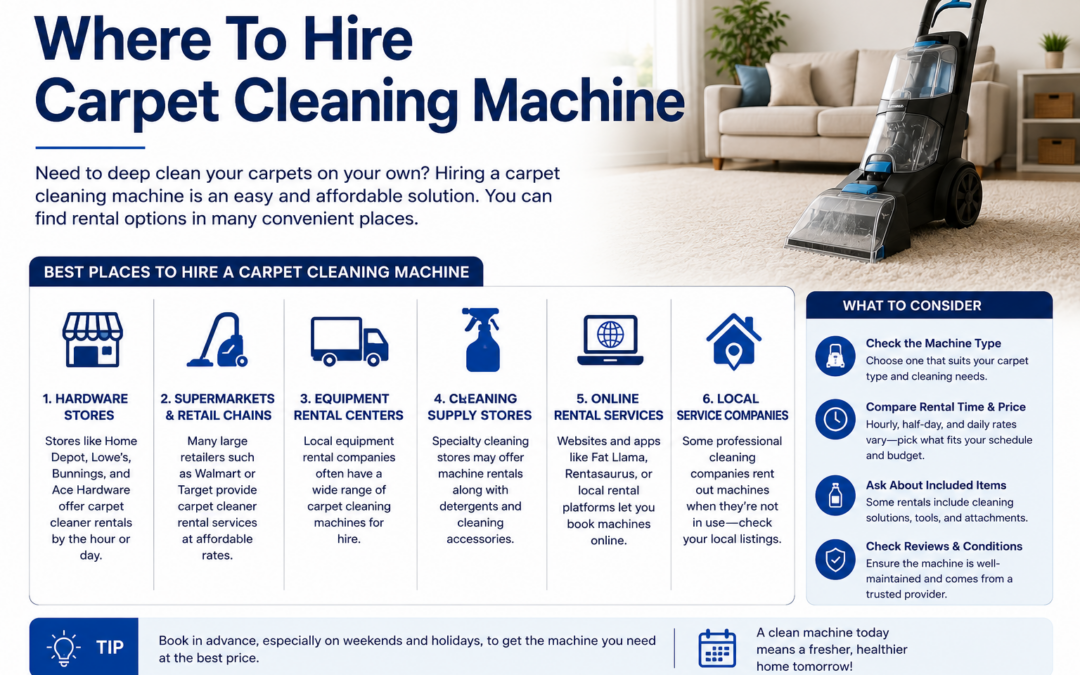
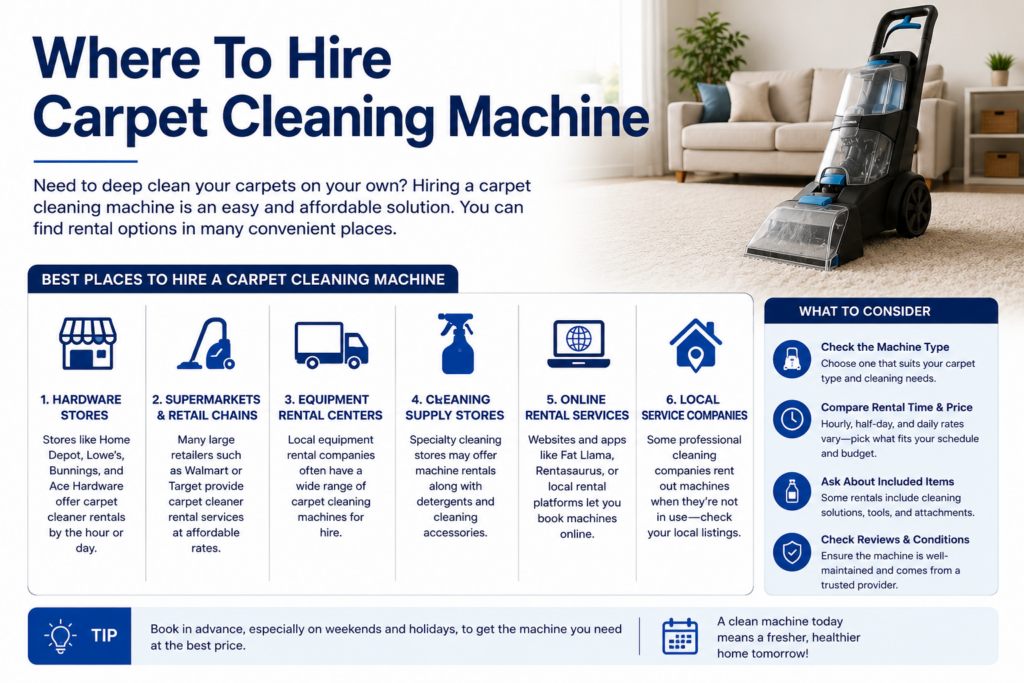
The best place to hire a carpet cleaning machine is usually a local home-improvement store, grocery store, or equipment-rental counter that offers a carpet cleaner rental with clear pricing, a short rental window, and the right cleaning solution for your carpet type. For most households, the key decision is not just where to rent one, but whether the machine, chemicals, and rental length actually fit the size of the job and the amount of drying time you have.
This guide explains how carpet cleaning machine hire works, where people typically rent them, what to watch for, and how to avoid the common mistakes that lead to sticky residue, weak cleaning results, extra fees, or damaged carpet. It also covers the real-world tradeoffs between renting, buying, and hiring a professional service, so you can choose the option that makes the most sense for your home or business. If you want better results and fewer headaches, expert guidance can help you choose the right machine, formula, and cleaning process before you start.
What Carpet Cleaner Hire Means
Carpet cleaner hire means renting a machine that sprays cleaning solution, agitates the carpet fibers, and extracts dirty water so you can deep-clean carpets yourself. In practice, this usually means a Rug Doctor- or BISSELL-style upright cleaner from a retailer, although commercial carpet extractor rentals are also available for larger jobs.
The main parties involved are the rental store, the machine manufacturer, the cleaning-formula brand, and you as the renter. Most stores require a photo ID, a rental agreement, and sometimes a deposit or extra fee for accessories such as upholstery tools. The process usually goes like this: reserve or pick up the machine, choose an approved solution, vacuum first, pretreat stains, clean in slow passes, then return the machine on time and clean enough to avoid fees.
What is included varies by location. The rental may include the machine only, while solution, stair tools, and spot cleaners are often separate charges. As a rule, EPA guidance says consumers should follow manufacturer recommendations and industry standards for keeping carpet clean, rather than relying on a single official federal carpet-cleaning schedule.
Best Places to Rent
Home-improvement stores
Home-improvement chains are among the most common places to hire a carpet cleaning machine because they combine convenience, broad availability, and straightforward pickup instructions. Lowe’s, for example, offers BISSELL Big Green rentals, and Home Depot lists Rug Doctor rentals at many locations.
This option is best when you want a dependable machine for a standard home job and do not need commercial-grade extraction. The biggest advantage is simplicity: you can usually reserve, pick up, and return the unit in the same place with minimal setup. The drawback is that inventory can vary by store, and same-day availability is not always guaranteed.
Grocery and warehouse stores
Some grocery and warehouse stores also rent carpet cleaning machines, often through third-party brands such as Rug Doctor. These locations are useful if you want a nearby pickup point and are already running errands in the same area.
The main benefit is convenience, especially for last-minute cleaning before guests, move-out day, or pet accidents. The limitation is that smaller locations may have fewer machines, fewer accessories, or shorter rental windows than dedicated home-improvement stores. Always confirm whether the store has the upholstery tool, approved solution, and return policy you need.
Equipment rental providers
For bigger jobs, commercial spaces, or heavily soiled carpet, equipment-rental providers can be a better fit than retail rental counters. These providers often carry carpet extractors and other floor-care tools intended for larger-scale cleaning.
This option makes sense when you need more power, larger tanks, or longer rental flexibility than a consumer machine usually offers. The tradeoff is that the rental process may be more formal, the machines may be heavier, and the learning curve may be steeper. If the carpet covers a large office, church, rental property, or multi-room facility, commercial rental equipment can save time compared with a standard upright cleaner.
8 Key Things To Know
1. Rental price is only part of the cost
A common mistake is focusing on the daily rental rate while ignoring solution, tool, and late-return costs. Many rentals start around $39.99 for 24 hours or $49.99 for 48 hours, but the final cost can rise once you add cleaner, spot tools, or extra days.
This matters because carpet cleaning is usually a two-part purchase: the machine plus the consumables. If you have a large house, multiple stain types, or stairs, you may need more than one bottle of solution or an add-on upholstery tool. Planning those extras up front helps you avoid underestimating the real price.
The best way to handle this is to compare the total cost, not just the advertised rental fee. Ask what is included, whether cleaning formula is sold separately, and whether you will need an additional charge for a second day.
2. The machine type should match the job
Not every carpet cleaning machine is built for the same task. Upright rentals are usually best for whole-room carpet cleaning, while portable spot cleaners are better for small stains, car interiors, stairs, or furniture.
This matters because using the wrong machine can waste time and produce poor results. A small portable unit is convenient, but it may take much longer to clean a full basement or multiple bedrooms. A large upright machine may be powerful enough for broad flooring, but it can be cumbersome in tight spaces.
Choose the machine based on square footage, stain severity, and mobility. If you are only cleaning one chair and a hallway runner, a spot cleaner may be enough; if you are cleaning an entire home, an upright rental is usually the better fit.
3. Cleaning solution matters as much as the machine
Rental stores often require or strongly recommend specific formulas that are compatible with the machine. Using the wrong product can create too much foam, leave residue behind, or even damage the equipment.
This matters because residue is one of the main reasons carpets feel sticky after DIY cleaning. Too much detergent can also attract dirt faster after the carpet dries. For many renters, the biggest improvement in results comes not from a bigger machine, but from using the correct formula at the correct dilution.
The practical fix is simple: read the machine instructions and measure carefully. Do not “eyeball” detergent amounts, and do not assume a stronger mix cleans better.
4. Prepping the carpet changes the outcome
Vacuuming first and pretreating spots can dramatically improve results. Skipping prep is one of the biggest reasons renters feel disappointed with a machine that was actually working fine.
This matters because carpet cleaners are not designed to remove loose debris efficiently. If the fibers are full of grit, hair, and surface dust, the cleaner spends more time moving dirt around than extracting embedded soil. Pretreating stains also gives the machine a better chance of lifting old spills instead of just lightening them.
A good routine is vacuum, pretreat, then clean slowly in overlapping passes. That simple sequence often produces a better result than making fast passes with extra detergent.
5. Drying time is part of the rental plan
One of the most overlooked details in carpet cleaner hire is how long carpets need to dry after use. The more water you apply, the longer drying takes, especially in humid rooms or thick pile carpet.
This matters because wet carpet can delay room use, create odors if left damp, and make the space inconvenient for pets or children. People who choose a one-day rental but underestimate drying time often end up with a room they cannot fully use until the next day.
To reduce that risk, use slow but controlled extraction, avoid over-wetting, and plan for fans or ventilation. If you need the room back quickly, consider a 48-hour rental or hire a professional service that can help manage moisture more efficiently.
6. Late returns and deposit rules can surprise you
Stores commonly require the machine to be returned on time, and some locations may charge extra for a missed deadline or missing accessory. ID, payment method, and rental paperwork are usually required at pickup.
This matters because the cheapest rental can become expensive if you return it late or lose a tool. People who rent near closing time sometimes discover they do not have enough hours left to finish the job properly.
The safest approach is to rent earlier in the day than you think you need and confirm the return window before leaving the store. Keep every accessory together, and photograph the machine condition when you pick it up and when you return it if the store allows that practice.
7. Not every stain is a rental-machine job
Carpet cleaner rentals work well for general soil, pet messes, and many common spills, but they are not the right solution for every problem. Some stains are set in, some dyes can be stubborn, and some carpets are delicate or require specialized care.
This matters because over-cleaning can cause fiber distortion, color loss, or wicking, where a stain seems to disappear and then reappears after drying. Delicate wool or antique rugs may need a gentler method than a standard rental machine.
If you are dealing with a valuable rug, a severe odor problem, or damage from flooding or mold, professional evaluation is usually smarter than trial and error. When the carpet is expensive or the stain is unusual, the risk of making it worse outweighs the cost of the rental.
8. Commercial jobs need a different approach
For offices, rental properties, and larger facilities, consumer rental machines may not be enough. Commercial carpet extractors are built for scale and can be better suited to heavy traffic and repeated use.
This matters because a small upright cleaner can take too long and may not extract enough water from high-traffic carpet. In a business setting, time lost to cleaning directly affects operations, tenants, customers, and staff.
The practical solution is to match the equipment to the space. If you are cleaning a lobby, conference center, or multi-unit property, ask specifically about commercial carpet cleaner rentals rather than consumer models.
Real Cost Of Getting It Wrong
The financial cost of a bad rental decision can include extra detergent, a second rental day, late fees, and the cost of fixing residue or repeat stains. The time cost is often worse: you may spend hours cleaning, only to discover the carpet still looks dull or smells damp the next day.
There are also emotional costs. DIY carpet cleaning often happens before guests arrive, during a move, or after a mess involving kids or pets, so frustration can spike when the result is not what you expected. In some cases, a poor cleaning attempt can damage trust between roommates, tenants, or family members who expected a better outcome.
Most of these costs are preventable with basic planning: choose the right machine, use the correct formula, test a small area first, and allow enough time for drying. When the job is large, delicate, or time-sensitive, a professional can reduce risk and prevent repeat work.
How An Experienced Pro Helps
An experienced carpet cleaning professional helps by choosing the right method before the first pass is made. That includes evaluating the carpet fiber, the stain type, the level of soil, and whether low-moisture or extraction cleaning is the better fit.
A pro also helps with preparation and execution: moving furniture appropriately, applying the right pretreatment, controlling moisture, and avoiding residue. If something goes wrong, such as a stain reappearing or a carpet staying too wet, an experienced provider knows how to troubleshoot the problem instead of guessing. For readers deciding between hire, buy, or professional service, that guidance can save time, reduce mistakes, and improve the final result.
Options And Tradeoffs
Rent a machine
Renting is the most common DIY option because it is relatively affordable and gives you access to stronger equipment than many home units. It works best for moderately sized homes and routine cleaning.
Its limitations are the time pressure, the need to learn the machine quickly, and the fact that you are responsible for technique and results. Renting makes the most sense when you can dedicate a few hours and your carpet is in decent condition.
Buy a machine
Buying can be worthwhile if you clean often, have pets, or want flexibility without a return deadline. It is a better long-term option for households that expect repeated use.
The downside is upfront cost and storage. Unless you will use it regularly, buying may cost more than the occasional rental.
Hire a professional
Hiring a professional is the best option for heavy soil, valuable carpet, stubborn odors, or situations where moisture control matters most. It usually costs more than renting, but it reduces labor and risk.
The limitation is price and scheduling. Even so, for larger or more delicate jobs, professional service is often the most efficient path.
If You Need One Today
- Measure the areas you need to clean and estimate how long the job will take.
- Call nearby rental stores to confirm availability, rental length, solution requirements, and accessory options.
- Ask whether the machine is upright or portable and whether it is suitable for your carpet type.
- Pick up the right cleaning formula and any pretreatment products before starting.
- Vacuum first, then test a small hidden area.
- Clean slowly in overlapping passes and avoid over-wetting.
- Use fans and ventilation to speed drying.
- Return the machine on time with all accessories.
How To Choose The Right Provider
Look for a rental provider that has clear pricing, current inventory, and simple instructions. The best providers make it easy to understand what is included, what is extra, and how the return process works.
Check for these points:
- Relevant experience with carpet cleaning rentals.
- Clear, plain-English instructions.
- A machine that matches your job size.
- Availability of cleaning solution and accessories.
- Reasonable pickup and return rules.
- Responsive staff who can explain setup and formula use.
- Options for larger or more specialized jobs, if needed.
For local help and service guidance, Double Take Carpet Cleaning is a suitable contact point if you want a professional opinion before choosing a rental or service path.
Common Mistakes
- Renting too late in the day and running out of time.
- Using too much detergent and leaving residue behind.
- Skipping vacuuming and stain pretreatment.
- Choosing a spot cleaner for a whole-house job.
- Not checking accessory and return fees.
- Ignoring carpet fiber type and sensitivity.
- Underestimating drying time.
- Waiting too long to address a stubborn stain.
FAQs
Where can I hire a carpet cleaning machine near me?
Most people start with home-improvement stores, grocery-store rental counters, or equipment-rental companies. Availability depends on location, so calling ahead is the fastest way to confirm.
How much does it cost to rent one?
Common retail rentals are often around $39.99 for 24 hours or $49.99 for 48 hours, but pricing varies by store and location. Add cleaning solution and optional tools to get the real total.
Do I need to buy cleaning solution separately?
Usually yes. Many stores sell or require a compatible formula, and it is smart to confirm that before pickup.
Is a carpet cleaner the same as a steam cleaner?
Not exactly. Many rental machines are hot-water extraction units rather than true steam cleaners, even though people use the terms loosely.
Can I use any detergent in the machine?
No. You should use the solution recommended by the rental provider or manufacturer. The wrong detergent can foam excessively or leave residue.
How long do I get the machine for?
Common rental windows are 24 hours or 48 hours, depending on the store and location. Some stores may offer shorter or longer terms.
Do I need an ID?
Most stores require a government-issued photo ID and a rental agreement.
Can I clean upholstery with a rented machine?
Often yes, if you rent the correct attachment or upholstery tool. Check availability before pickup.
Is renting better than hiring a professional?
Renting is usually cheaper, but professional cleaning is better for large, delicate, or high-risk jobs. The best choice depends on budget, time, and carpet condition.
How much carpet can one rental clean?
That depends on machine size, soil level, and how much solution you use. A standard upright rental is typically suitable for several rooms in a home.
How long does carpet take to dry?
Drying time varies based on pile thickness, humidity, airflow, and how wet the carpet gets during cleaning. Better extraction and ventilation shorten the wait.
Can I rent on the same day?
Often yes, if the store has inventory. Same-day pickup is common, but not guaranteed.
What should I do before using the machine?
Vacuum thoroughly, move small furniture, and pretreat spots. Also read the rental instructions before filling the tank.
What happens if I return it late?
Late returns can trigger extra charges, depending on the store policy. Confirm the due time at pickup so you can plan the job realistically.
Are rental machines good for pet stains?
Yes, many are suitable for common pet stains and odors when paired with the right formula. Severe odor or recurring contamination may need professional treatment.
Can I use a rental machine on area rugs?
Sometimes, but only if the rug material and dye stability can handle wet cleaning. Check the rug care label first.
Is commercial equipment different from store rentals?
Yes. Commercial carpet extractor rentals are usually larger and more powerful, and they are better for big facilities.
What if the stain comes back after cleaning?
That can happen if soil or liquid wicks up from deep in the fibers. A second targeted treatment or professional assessment may be needed.
Should I test a hidden area first?
Yes. A spot test helps you check for color change or fiber sensitivity before cleaning the whole room.
Do carpet cleaners work on old stains?
Sometimes, but older stains are harder to remove completely. Pretreatment and repeated careful passes may help, but not all stains can be fully lifted.
Is it okay to over-wet the carpet to get better results?
No. Excess moisture can slow drying and increase the chance of residue or odor problems. Slow passes with strong extraction are better.
What is the biggest mistake first-time renters make?
They underestimate prep, overuse detergent, and rush the process. Those three mistakes cause most poor results.
Can I hire a machine for stairs?
Yes, if the rental offers an upholstery or stair tool. That attachment makes narrow areas easier to clean.
When should I choose a pro instead?
Choose a pro when the carpet is expensive, heavily soiled, moisture-sensitive, or tied to a time-sensitive event. The extra cost is often worth the reduced risk.
Rules And Standards
There is no single federal rule that dictates how often carpet must be cleaned, and EPA says consumers should follow manufacturer recommendations and industry standards for indoor air quality and carpet care. For residential carpet, the Carpet and Rug Institute’s Seal of Approval program is a commonly recognized industry framework for cleaning products and equipment. In practical terms, that means using approved products, following the carpet manufacturer’s care instructions, and avoiding aggressive methods that could damage the carpet.
Conclusion
If you are trying to figure out where to hire a carpet cleaning machine, the smartest choice is the one that matches your room size, carpet type, schedule, and comfort level with DIY work. In most cases, a home-improvement store or nearby rental counter is the easiest place to start, but the total cost, the cleaning solution, and the return rules matter just as much as the machine itself.
Most carpet-cleaning mistakes are avoidable with a little planning, the right formula, and enough time for drying. If the job feels large, delicate, or time-sensitive, a professional can help you avoid expensive mistakes and get a better result the first time. Contact Double Take Carpet Cleaning for guidance related to carpet cleaner rental and the best next step for your situation.
